Why Jewelers in Canada, Switzerland, and Chile Are Investing in Laser Welding Machines
Meta Description: Discover why jewelry workshops in Canada, Switzerland, and Chile are investing in jewelry laser welding machines for gold, silver, platinum, watch repair, and precision jewelry production.
Three Very Different Markets—and One Common Question
Over the past few years, something has caught my attention.
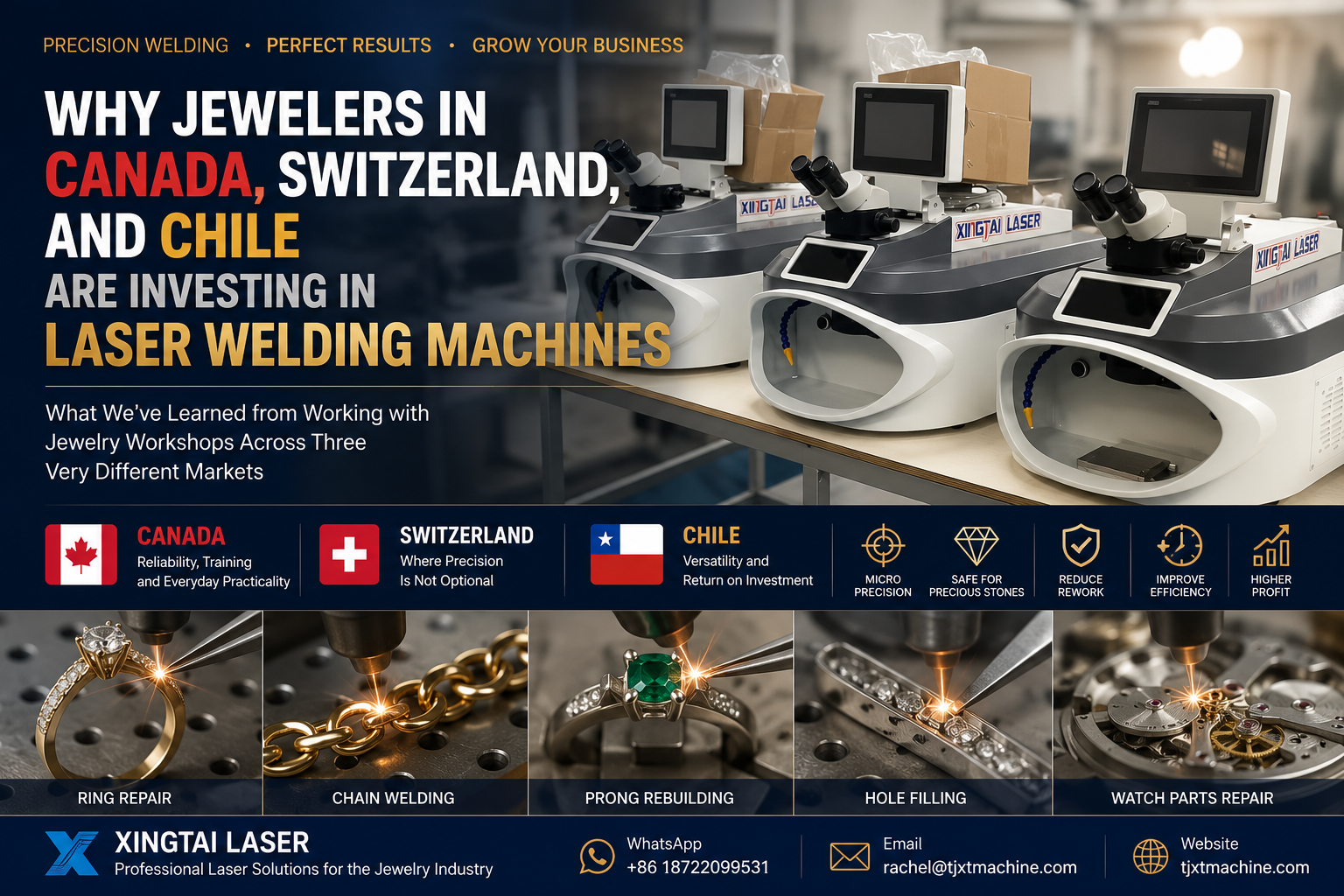
We have supplied and discussed jewelry laser welding machines with customers in Canada, Switzerland, and Chile. On paper, these markets have very little in common.
A small jewelry repair shop in Canada does not operate like a luxury watch workshop in Switzerland.
A family-owned jewelry store in Chile may have a completely different budget, customer base, and production volume.
Yet their questions often sound surprisingly similar:
Can the machine weld gold and silver?
Will the heat damage gemstones?
Is it difficult for a beginner to operate?
What happens if we need technical support after delivery?
That tells me something important.
Jewelry laser welding is no longer a technology reserved for large jewelry factories. It is becoming a practical production and repair tool for smaller workshops, independent jewelers, watch repair businesses, and custom jewelry studios.
The reasons are not identical in every country, though.
Canadian customers often care about reliability and ease of use.
Swiss buyers usually focus on precision and finishing quality.
Chilean customers frequently ask about investment return and whether one machine can handle enough applications to justify the cost.
Same machine category. Very different buying logic.
Why Traditional Jewelry Soldering Still Has a Place
Before discussing laser welding, I should say something that some equipment sellers avoid saying:
Traditional torch soldering is not obsolete.
It is affordable, familiar, and still useful for many standard jobs. An experienced jeweler can do excellent work with a torch.
The problem appears when the work becomes smaller, more delicate, or more valuable.
Traditional soldering introduces heat to a relatively large area. That can lead to:
-
Discoloration and oxidation
-
More polishing after repair
-
Possible distortion of thin parts
-
Stone removal before welding
-
Greater risk near heat-sensitive components
-
Longer finishing and rework time
I have spoken with jewelers who were not unhappy with soldering itself. They were unhappy with everything that happened after soldering.
The cleaning.
The polishing.
The stone removal.
The risk of doing the same repair twice.
That is where a jewelry laser welding machine begins to make sense.
How Jewelry Laser Welding Changes the Repair Process
A jewelry laser welder concentrates energy on a very small area.
Instead of heating the entire piece, the operator applies short laser pulses directly to the joint or damaged section. Under a microscope, the welder can repair a crack, close porosity, reconnect a chain, resize a ring, or rebuild a worn area with much more local control.
The practical benefits are easy to understand:
-
Smaller heat-affected zone
-
Less deformation
-
Reduced oxidation
-
Less polishing after welding
-
Better control around gemstones
-
More precise repair of thin and delicate pieces
Does that mean every repair becomes effortless?
No.
The operator still needs to understand the metal, joint design, focus position, pulse energy, welding wire, and microscope alignment.
But once the basic technique is learned, the process becomes far more controlled than many first-time buyers expect.
Canada: Reliability, Training, and Everyday Practicality
Canadian Buyers Usually Want a Machine Their Team Can Actually Use

Many Canadian inquiries we receive come from jewelry repair shops, independent jewelers, custom design studios, and small manufacturers.
These buyers are usually practical.
They do not always ask for the highest power or the most complicated configuration. They ask questions such as:
How quickly can my staff learn it?
Can it weld both gold and silver?
Will you provide remote training?
What happens if we need a spare part one year later?
One Canadian customer explained it very clearly:
“I do not need the fastest machine. I need one that works every day and does not become a problem for my staff.”
Honestly, that is a very sensible way to buy industrial equipment.
For many Canadian workshops, the value of a jewelry laser welding machine comes from handling everyday jobs more consistently:
-
Ring resizing
-
Chain repair
-
Prong rebuilding
-
Porosity repair
-
Earring and clasp repair
-
Custom jewelry modification
-
Small watch and metal component repair
The machine does not need to be oversized. It needs to be stable, easy to adjust, and supported properly after delivery.
After-Sales Support Matters More Than the Specification Sheet
Canadian customers often pay close attention to documentation and support.
They want:
-
Clear operating manuals
-
Video training
-
Parameter guidance
-
Remote troubleshooting
-
Reliable warranty terms
-
Spare-parts availability
This is understandable. A small workshop may not have an in-house laser engineer.
If the machine stops, the owner cannot simply move production to another department. The repair business may stop with it.
That is why I always say: for a small jewelry workshop, supplier response time can matter as much as laser performance.
Switzerland: Precision Is Not a Marketing Word
Swiss Customers Often Ask Different Questions

Swiss jewelry and watch customers tend to approach the machine from another angle.
They are less likely to begin with:
What is your lowest price?
They are more likely to ask:
How small is the welding spot?
How stable is the pulse?
Can it work close to a gemstone?
Can it repair a small watch component without affecting the surrounding area?
That changes the entire sales conversation.
In high-value jewelry and watch work, the cost of one damaged component may be far higher than the price difference between two machines.
So the buyer focuses on control.
Not just power.
Why Microscopic Control Matters
For Swiss watch repair, luxury jewelry, platinum pieces, and precision components, the operator may need to work on an extremely small area.
The important factors often include:
-
Stable pulse output
-
Fine spot adjustment
-
Clear microscope visibility
-
Accurate positioning
-
Low and controllable heat input
-
Repeatable welding results
A machine that is “powerful” but difficult to control is not necessarily useful for this kind of work.
In fact, too much energy can create more problems than it solves.
This is something new buyers sometimes misunderstand. They see a higher number and assume it means a better machine.
For jewelry laser welding, control is often more valuable than maximum power.
Gold, Platinum, and Watch Components
Swiss customers commonly care about premium materials and delicate work.
Gold is usually manageable with the correct parameters and filler wire.
Platinum often requires careful energy control and proper technique.
Silver can be more demanding because it reflects heat and conducts it away quickly. It can still be welded, but the process may require different settings and more operator experience.
Watch components add another challenge: size.
The weld may be technically successful, but if the operator creates unnecessary heat, distortion, or finishing work, the repair is not truly successful.
For this market, the best result is often the one that needs the least correction afterward.
Chile: Versatility and Return on Investment
Chilean Buyers Often Ask the Most Practical Business Question

Many Chilean customers ask:
How long will it take for this machine to pay for itself?
That is a fair question.
A jewelry laser welder is not a decorative purchase. It must generate revenue, save labor, reduce outsourcing, or help the shop accept jobs it previously had to reject.
Chilean buyers are often interested in a machine that can cover multiple daily applications:
-
Gold and silver repair
-
Ring resizing
-
Chain repair
-
Filling small holes
-
Restoring worn areas
-
Welding near stones
-
Small custom production
For a workshop with limited space and a controlled investment budget, versatility matters.
The Real ROI Is Not Only the Welding Fee
When calculating return on investment, many people only consider the price charged for each repair.
That is only part of the picture.
A jewelry laser welding machine may also help a workshop:
-
Keep repair work in-house
-
Reduce transport to outside repair specialists
-
Shorten customer waiting time
-
Accept more complex jobs
-
Reduce rework and polishing
-
Improve confidence when handling valuable pieces
Suppose a shop sends difficult repairs to another workshop every week.
The cost is not only the outsourcing fee. There is also transport time, communication, delay, and the risk of losing control over the customer experience.
Once the repair can be completed in-house, the business changes.
How fast the machine pays back depends on workload, local pricing, repair volume, and operator efficiency. I would be cautious about promising an exact number.
But for a busy repair shop, the return can be much faster than expected.
What Customers in All Three Countries Have in Common
Canada, Switzerland, and Chile have different customer profiles, but the same concerns appear again and again.
Can One Machine Weld Gold, Silver, and Platinum?
In many cases, yes—but not with one universal setting.
Each material behaves differently.
Gold is generally friendly to laser welding.
Platinum can produce excellent results with proper control.
Silver is often more challenging because of its thermal conductivity and reflectivity.
The machine configuration matters, but operator technique matters too.
Can the Machine Weld Near Gemstones?
Laser welding can reduce the need to remove stones because the heat-affected zone is small.
Still, “can weld near stones” should never be treated as a blanket promise.
Different gemstones respond differently to heat, shock, coatings, inclusions, and previous treatments.
Diamonds are not the same as emeralds.
Sapphires are not the same as opals.
A professional operator should understand the stone before welding close to it.
Is the Machine Difficult to Learn?
The basic operation is usually not difficult.
Becoming good at it takes practice.
Most new users can learn how to adjust the microscope, position the workpiece, select parameters, and make basic welds through structured training.
The finer skills—matching filler wire, controlling penetration, repairing thin chains, working around delicate stones—develop with experience.
That is normal.
No serious supplier should promise that a beginner will become a master jeweler in one afternoon.
Do I Need the Highest-Power Machine?
Usually not.
Jewelry welding is about short, controlled pulses and precise energy delivery.
A higher-power model may provide more flexibility for thicker work or faster filling, but excessive power does not automatically create a better weld.
The correct configuration depends on the actual work.
A repair shop handling rings and chains may need something different from a manufacturer producing heavier platinum pieces.
What to Look for in a Jewelry Laser Welding Machine
A Clear and Comfortable Microscope
The operator may spend hours looking through the microscope.
Image clarity, comfortable working distance, and good illumination matter more than they appear on a brochure.
A poor microscope makes precise work tiring.
Stable Laser Output
Consistency is essential.
The machine should deliver repeatable pulse energy. Unstable output makes it harder for the operator to build skill because the same settings may produce different results.
Easy Parameter Adjustment
The operator should be able to control settings such as:
-
Energy
-
Pulse width
-
Frequency
-
Spot size
The interface does not need to look futuristic.
It needs to be clear and practical.
Effective Cooling
Jewelry welding machines may use air cooling or water cooling depending on the design and power.
The important point is that the cooling system matches the workload and local environment.
A shop completing occasional repairs has different needs from a workshop running the machine for long production shifts.
Training and Long-Term Support
This deserves repeating.
Ask the supplier:
-
Who provides training?
-
Is remote support available?
-
Are parameter recommendations included?
-
What does the warranty cover?
-
Are spare parts available later?
-
Will the supplier still answer after the payment is complete?
You are not only buying a laser source and a metal cabinet.
You are buying the support around them.
Should Every Jewelry Workshop Buy a Laser Welder?
No.
A workshop with very little repair volume may not recover the investment quickly.
A jeweler who only performs simple torch soldering jobs may not need one immediately.
But the machine becomes more attractive when the business regularly handles:
-
High-value jewelry
-
Stone-set pieces
-
Custom designs
-
Difficult repairs
-
Platinum or fine gold work
-
Watch components
-
Daily ring and chain repairs
-
Jobs currently outsourced to other workshops
At that point, laser welding is not just about owning newer technology.
It is about gaining control over quality, delivery time, and customer service.
Final Thoughts
Working with jewelry customers in Canada, Switzerland, and Chile has taught me that there is no single reason people buy a jewelry laser welding machine.
Canadian workshops often want dependable equipment and strong support.
Swiss customers care deeply about precision and control.
Chilean buyers usually look closely at versatility and return on investment.
But underneath those differences is the same goal:
They want to repair valuable pieces with less risk and more confidence.
That is the real value of jewelry laser welding.
It does not replace craftsmanship.
It gives skilled jewelers a more precise tool.
And when the machine, training, and application are matched correctly, it can change not only how a workshop completes repairs, but also which jobs it is willing to accept.
Frequently Asked Questions
Can a jewelry laser welding machine weld gold?
Yes. Jewelry laser welders are widely used for repairing and joining different gold alloys. The correct parameters and matching filler wire are important.
Can it weld silver jewelry?
Yes, but silver is generally more challenging because it conducts heat quickly and reflects laser energy. Proper parameters and operator experience are especially important.
Can it weld platinum?
Yes. Laser welding is well suited to many platinum jewelry applications because it offers localized and precise heat input.
Can jewelry be welded without removing stones?
In some cases, yes. The small heat-affected zone can reduce the need for stone removal. However, the gemstone type and condition must be evaluated before welding.
Is a jewelry laser welder suitable for watch repair?
It can be suitable for certain metal watch components and precision repairs, provided the machine offers fine control and the operator understands the application.
How long does training take?
Basic machine operation can often be learned relatively quickly. Developing consistent professional welding skills requires practice and experience.
Is laser welding better than traditional soldering?
Neither method is ideal for every job. Laser welding is particularly valuable for precision repairs, heat-sensitive pieces, stone-set jewelry, and jobs requiring minimal finishing.
Contact XINGTAI Laser
XINGTAI Laser provides jewelry laser welding solutions for repair shops, custom jewelry studios, watch workshops, and jewelry manufacturers.
We can recommend a suitable configuration based on your materials, repair volume, product size, and local operating requirements.
WhatsApp: +86 18722099531
Email: rachel@tjxtmachine.com
Website: tjxtmachine.com