Cutting Speed Is Not the Whole Story: Why Uptime Matters in Fiber Laser Cutting
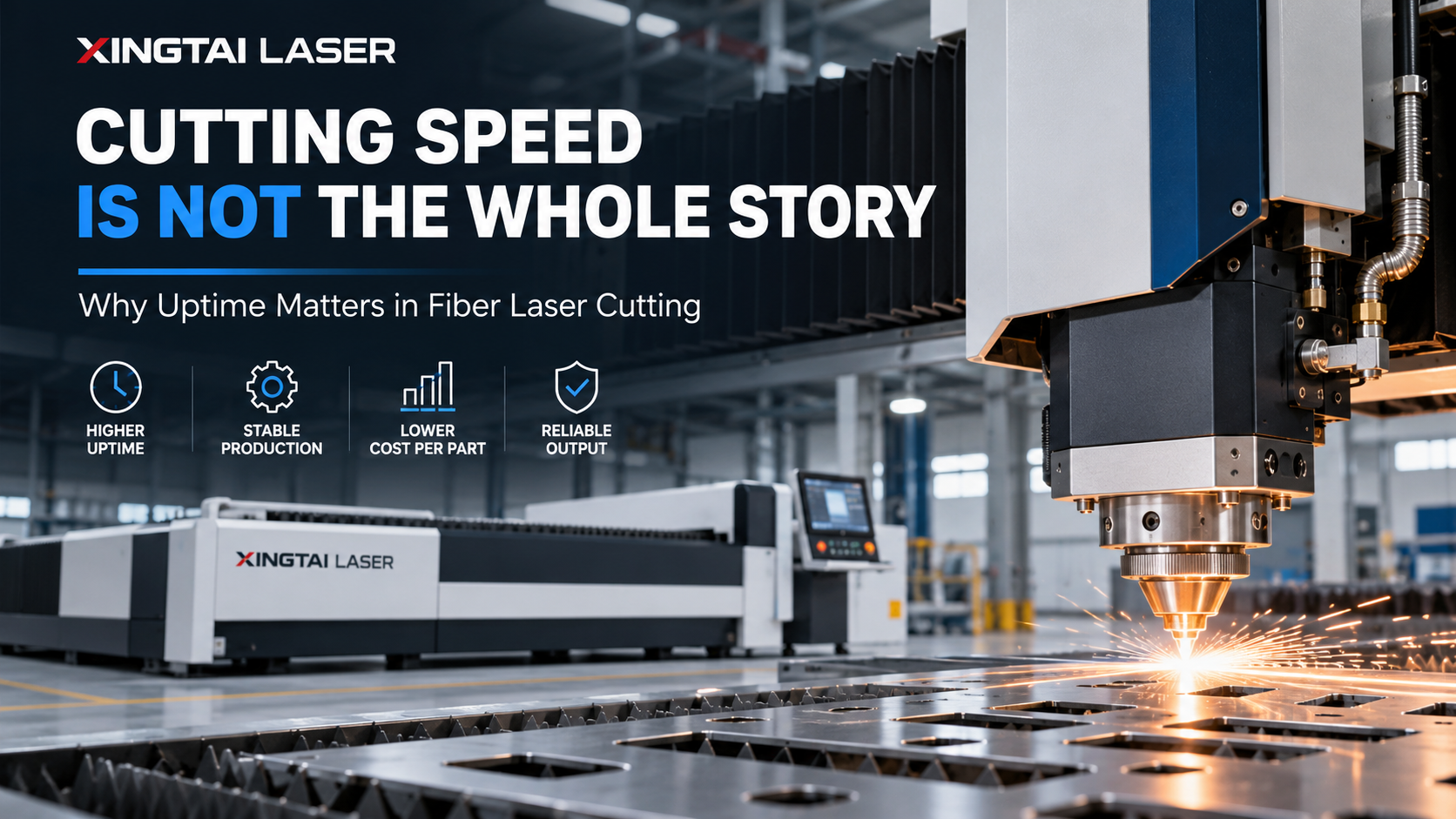
When manufacturers compare fiber laser cutting machines, the discussion often begins with laser power and cutting speed.
How many kilowatts does the machine have?
How quickly can it cut stainless steel?
What is the maximum cutting thickness?
These are important questions. However, they do not tell the complete story of production efficiency.
A machine may cut extremely quickly when everything is working perfectly. But if production is frequently interrupted by nozzle problems, incomplete cuts, material handling delays or unexpected downtime, its actual output may be much lower than expected.
That is why a different question is becoming increasingly important:
How many acceptable parts can the machine produce during a real working shift?
Recent developments in industrial laser cutting suggest that manufacturers are paying greater attention to this question.
1. A New Focus on Production Reliability
On October 9, 2026, TRUMPF announced a new generation of its TruLaser 5000 series ahead of EuroBLECH 2026.
Among the highlighted developments were real-time process monitoring, nozzle-condition checks, automatic feed-rate adjustments and functions designed to resume interrupted cuts.
The announcement illustrates a broader shift in equipment development: improving productivity by reducing interruptions, not simply increasing cutting speed.
For manufacturers, this distinction matters.
A machine that cuts faster but stops frequently may not produce more finished parts than a slower, more reliable system.
2. Cutting Speed and Production Output Are Different
Consider two hypothetical laser cutting machines operating during an eight-hour shift.
Machine A has a higher cutting speed but experiences repeated interruptions.
Machine B cuts somewhat more slowly but operates consistently.
At the end of the day, Machine B may have produced more acceptable components.
The reason is simple.
Actual production includes more than laser-on cutting time.
It also includes:
- Material loading and unloading
- Piercing and positioning
- Program changes
- Nozzle inspection
- Part removal
- Quality inspection
- Troubleshooting and maintenance
The time spent on these activities affects the number of finished parts a factory can deliver.
A small interruption can erase the advantage of a faster cut.
3. Why Nozzle Condition Matters
The cutting nozzle is a relatively small component, but it plays an important role in the cutting process.
Its condition can influence the delivery of assist gas and the stability of the cutting operation.
Contamination, damage or incorrect alignment may contribute to poor cutting results.
This is particularly important during continuous production.
An operator may discover a problem only after several parts have been processed.
That creates material waste and additional work.
The latest developments in laser cutting show increasing interest in identifying such problems earlier.
For example, the new TruLaser 5000 announcement describes a system that checks nozzle condition when contamination is detected.
This is a feature of that specific system, not a standard capability of every fiber laser cutter.
Nevertheless, it demonstrates why nozzle maintenance and process monitoring deserve attention.
4. The Hidden Cost of Interrupted Cuts
An interrupted cut can create several problems.
The operator may need to inspect the sheet, identify the interruption point and decide whether the part can be recovered.
Sometimes the workpiece can be processed again.
In other situations, the material may need to be discarded.
For a factory producing expensive components, the cost can become significant.
The latest generation of advanced laser cutting systems is introducing more sophisticated ways to identify interrupted cuts and resume processing.
The objective is straightforward:
Recover production whenever technically possible instead of automatically treating every interruption as a lost part.
However, successful recovery depends on the machine's control capabilities, material condition and the specific cutting process.
5. The Entire Workflow Determines Productivity
Laser cutting is only one part of metal fabrication.
A finished component may also require:
material preparation,
cutting,
part separation,
deburring,
bending,
welding,
inspection,
and packaging.
Improving cutting speed alone does not necessarily improve the complete workflow.
If parts are produced faster than operators can remove and sort them, a new bottleneck appears.
Likewise, a cutting machine that frequently waits for material cannot achieve its theoretical production capacity.
This is why manufacturers should evaluate the complete production process rather than focusing on one machine specification.
The question is not only how fast the beam moves, but how smoothly work moves through the shop.
6. Why This Matters for Small Manufacturers
For a large factory with several production lines, one machine stopping may not completely interrupt production.
For a small workshop with only one laser cutter, the situation can be different.
If the machine stops, the entire cutting operation may stop.
That makes reliability especially valuable.
Small manufacturers should consider:
How easy is the machine to maintain?
Are replacement consumables readily available?
Can operators identify common faults?
Is technical support accessible?
Can the machine produce consistent results across different jobs?
How much production time is lost during changeovers?
These practical questions may be more important than a small difference in maximum cutting speed.
7. How to Evaluate the Real Cost per Part
A useful way to compare equipment is to consider the cost of producing an acceptable component.
A simplified calculation is:
Cost per Good Part = Total Production Cost ÷ Number of Acceptable Parts
Total production cost may include:
machine operating expenses,
electricity,
assist gas,
consumables,
labor,
material waste,
maintenance,
and other production-related costs.
This calculation helps manufacturers look beyond equipment specifications.
A machine that produces fewer rejected parts and requires less unplanned maintenance may offer better overall economics, even if another machine has a higher advertised cutting speed.
8. What Should Buyers Ask Before Purchasing?
When comparing fiber laser cutting machines, buyers should ask more than questions about laser power.
They should also ask:
What materials and thicknesses will be processed most frequently?
What is the expected daily production volume?
How frequently will products change?
How easy is nozzle inspection and replacement?
What alarms and protective functions are included?
How are interrupted cuts handled?
What maintenance does the machine require?
What technical support is available after installation?
These questions help buyers select equipment based on real production requirements.
9. Higher Power Is Not Always the Best Investment
High-power fiber laser cutting systems are extremely valuable for appropriate applications.
However, higher power also requires a suitable overall machine configuration and a workload that justifies the investment.
A workshop producing small precision components may have very different requirements from a factory processing large steel sheets.
For small-batch manufacturing, a compact machine with suitable cutting capability may be a more practical investment than a much larger system.
The right decision depends on:
part dimensions,
material thickness,
required precision,
production volume,
available floor space,
and total operating cost.
The best machine is not necessarily the most powerful one. It is the machine that fits the production task.
10. The Future of Fiber Laser Cutting
The industry will continue developing faster and more powerful laser cutting equipment.
At the same time, manufacturers are paying increasing attention to production monitoring, fault prevention, recovery functions and workflow efficiency.
These technologies point toward a future in which cutting machines do more than follow programmed paths.
They may increasingly help operators recognize problems earlier, reduce unnecessary waste and maintain more consistent production.
Not every manufacturer needs the most advanced automated system.
But every manufacturer benefits from understanding where production time and material are being lost.
The goal is not to buy the most automated machine. It is to buy the right level of reliability for the work.
XINGTAI LASER Weekly Insight
For years, laser cutting equipment has been compared primarily by power and speed.
Those specifications remain important.
But manufacturers ultimately purchase equipment to produce finished components reliably and economically.
A machine that cuts quickly is useful.
A machine that consistently produces acceptable parts is even more valuable.
As the industry moves toward smarter production monitoring and more reliable cutting processes, equipment buyers should increasingly focus on one practical question:
What will this machine actually deliver during a normal working day?
Because in manufacturing, productivity is not measured only by how fast a machine can cut.
It is measured by how much good work gets finished.