A Handheld Laser Marking Machine Built for Real On-Site Work
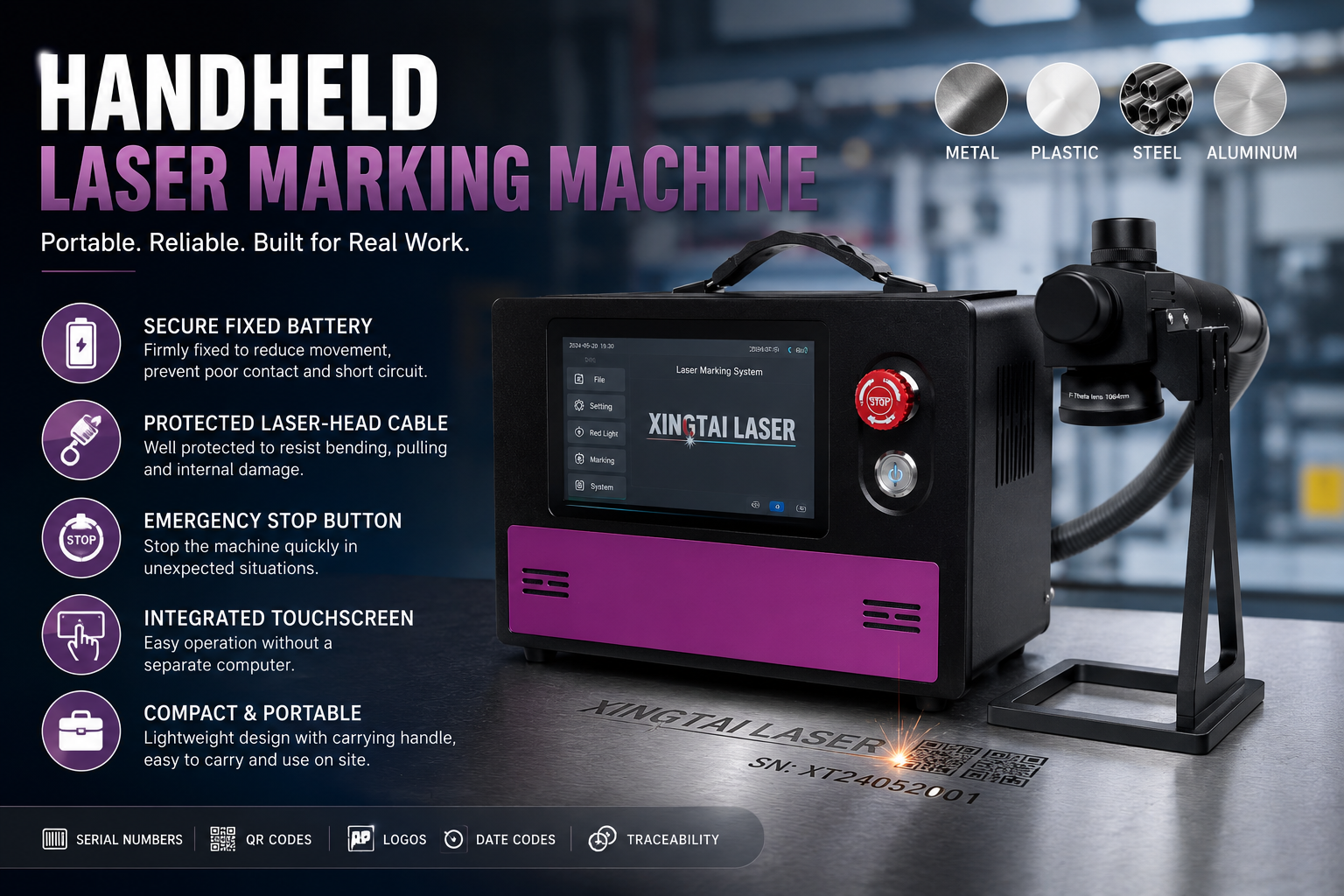
Meta Description: This portable handheld laser marking machine features a securely fixed battery, protected marking-head cable, emergency stop button, integrated touchscreen, and compact design for large parts and on-site marking.
The Problem Was Never Just Making the Machine Smaller
When customers first see this handheld laser marking machine, most of them notice the same things.
It is compact. It has a carrying handle. There is no large vertical column, no separate computer, and no heavy worktable.
Then they pick up the marking head and say:
“So I can take the laser to the product instead of bringing the product to the laser?”
Exactly.
That is the basic idea.
But, to be honest, making a laser marker portable is the easy part. The more difficult question is whether it will remain reliable after being carried between workshops, loaded into vehicles, moved around factories, and used from different angles every day.
A machine sitting permanently on one table lives a fairly easy life.
A portable machine does not.
Its battery moves with the machine. Its cable bends whenever the operator changes position. Its connectors experience vibration. The marking head may be picked up and put down dozens of times during one shift.
Those small details eventually matter more than a polished housing or an impressive specification sheet.
That is why this model focuses not only on portability, but also on the problems that portability can create.
Why We Developed This Handheld Laser Marker

We often hear from customers who need to mark products that simply do not fit under a conventional desktop laser machine.
Sometimes the component is too large.
Sometimes it is already installed.
Sometimes it weighs hundreds of kilograms, and moving it just to engrave one serial number makes no sense.
I have seen factories spend far more time moving a product than actually marking it. The laser may need ten seconds to create the code, while the workshop spends half an hour lifting, positioning, and securing the component.
That is the situation this machine is designed for.
Instead of moving the entire product, the operator takes the handheld marking head to the required location.
It sounds simple because it is simple.
And in the right application, it can save a surprising amount of time.
A Fixed Battery Sounds Like a Small Detail—Until It Is Not

One of the key improvements in this machine is the way the internal battery is secured.
Portable equipment is moved frequently. It may be carried from one department to another, transported to a customer site, or placed in a vehicle for mobile service work.
If the battery is not properly fixed, it may gradually shift inside the housing.
At first, the movement may be barely noticeable.
After repeated transportation, however, a loose battery can start pulling on terminals, wiring, plugs, and mounting points. That may lead to unstable contact or internal damage.
We have all seen products where the electrical design looks fine on paper, but the mechanical fixing was treated as an afterthought.
That is a mistake.
In this model, the battery is firmly restrained inside the machine. The fixing straps and support structure reduce movement during transportation and operation.
This helps protect the electrical connections and lowers the chance of faults caused by a battery repeatedly moving inside the cabinet.
It is not a glamorous feature.
It is simply good engineering.
And honestly, these are often the features that customers appreciate most after using the machine for several months.
The Marking-Head Cable Needs More Protection Than People Think

The cable between the main unit and the handheld marking head is constantly moving.
Every time the operator reaches across a machine, changes the marking angle, walks around a pipe, or works on the other side of a steel cabinet, the cable bends and twists.
That is normal.
The problem begins when all that movement is concentrated at one weak point.
A cable that is repeatedly pulled near the connector may eventually suffer from internal wire fatigue, damaged insulation, or unstable communication.
Sometimes the fault does not appear immediately.
The machine works normally for weeks. Then the marking signal cuts out occasionally. The operator moves the cable, and it starts working again.
That kind of intermittent problem is frustrating because it is difficult to diagnose.
This machine uses a protective outer tube and more controlled cable routing to reduce sharp bends, rubbing, and direct pulling around the marking head.
It does not make the cable indestructible. Nothing does.
The operator should still avoid dragging it over sharp metal edges or using the cable to lift the head. But a properly supported cable is far more likely to remain reliable under regular handheld use.
The Emergency Stop Is There for the Moment You Hope Never Happens
There is a physical emergency stop button on the front of the machine.
Some people may look at it and think it is just another standard component.
Maybe.
But when something unexpected happens, nobody wants to search through a touchscreen menu.
Perhaps the marking head slips.
Perhaps the cable becomes trapped.
Perhaps the product moves after the job begins.
Or perhaps the operator notices an unusual sound, smell, or system response.
In situations like these, the machine should be stopped immediately and clearly.
That is what the emergency stop is for.
Of course, it does not replace laser-safety training, controlled access, protective eyewear, correct positioning, or proper operating procedures.
It is the last quick action available when normal operation no longer feels normal.
And that matters.
Where a Handheld Laser Marker Makes the Most Sense
A handheld laser marking machine is not automatically better than a conventional machine.
It is better in specific situations.
For small parts that need to be marked repeatedly in exactly the same position, a fixed desktop marker with a jig may still be faster and more consistent.
But when the product is large, heavy, irregular, or already installed, the logic changes.
This machine is particularly useful for marking:
- Large machinery and equipment
- Metal cabinets and electrical enclosures
- Pipes, tubes, and steel structures
- Automotive components
- Agricultural machinery
- Molds and heavy tools
- Installed assemblies
- Large fabricated products
- Equipment maintenance information
- Asset-identification codes
One customer may use it to mark serial numbers on industrial machines.
Another may need QR codes on large pipe fittings.
A maintenance department may use it to add inspection dates directly to equipment that cannot be removed from the production line.
The common point is always the same:
The product is difficult to move, so the marking system has to move instead.
The Touchscreen Keeps the Portable System Actually Portable
The main unit includes an integrated touchscreen.
That means operators do not need to set up a separate desktop computer for normal work.
This seems obvious, but it makes a big difference on site.
Imagine carrying the laser unit, marking head, computer, monitor, keyboard, mouse, and all the necessary cables into a customer’s workshop.
At that point, it is no longer a truly portable system.
With the built-in interface, operators can manage common marking tasks directly from the machine.
Depending on the final controller and software configuration, this may include:
- Selecting marking files
- Entering text or serial numbers
- Adjusting speed and power
- Creating QR codes or barcodes
- Reviewing system status
- Starting and stopping jobs
- Managing commonly used templates
The interface does not need to look complicated.
In fact, for most production teams, a simple interface is better.
The operator should be able to arrive at the product, choose the file, confirm the position, and start work without turning the process into an IT project.
Battery Operation Gives More Freedom—but It Needs to Be Understood Properly
The machine includes an internal battery, making it suitable for jobs where a convenient power outlet is not nearby.
That can be useful in warehouses, maintenance areas, temporary production stations, exhibitions, and customer sites.
Still, battery operation is not magic.
Runtime depends on the actual configuration, laser power, marking frequency, file complexity, ambient temperature, and how continuously the system is used.
A customer marking one short serial number every few minutes will get a very different operating time from someone running continuous QR-code jobs.
So I prefer not to promise a dramatic fixed number before the final configuration has been tested.
A realistic tested range is far more useful than a nice-looking number in a brochure.
What matters here is that the machine combines battery operation with secure battery fixing.
Portability is useful.
Stable portability is better.
What Can It Mark?
With the correct laser configuration, the machine can create permanent identification on compatible metals and some plastics.
Typical marking content includes:
- Logos
- Serial numbers
- Product models
- QR codes
- Barcodes
- Data Matrix codes
- Production dates
- Batch numbers
- Warning information
- Equipment numbers
- Maintenance records
- Traceability data
For many industrial users, the variable-data capability is the real value.
They may not need one logo repeated thousands of times.
They need a different serial number on every product.
Or a unique QR code for each machine.
Or a new maintenance record added to equipment already operating in the factory.
That is where a portable laser marker becomes more than a convenient machine. It becomes part of the traceability system.
Handheld Does Not Mean Freehand
This is probably the most important operating point.
A handheld marking head still needs stable positioning and correct focus.
You cannot wave it over the product like a spray gun and expect a sharp Data Matrix code.
The marking head must be held against, or supported over, the product at the correct distance and angle. During marking, it should remain still.
For simple serial numbers on a large steel surface, this may be straightforward.
For a small QR code requiring high readability, the positioning needs to be much more controlled.
Depending on the application, a positioning frame, contact plate, spacer, or customized support may be helpful.
So yes, the system is handheld.
But the marking process still requires precision.
That is not a weakness of this machine. It is simply how laser marking works.
The Marking-Head Stand Is More Useful Than It Looks
The machine comes with a separate stand for the handheld marking head.
This may seem like a minor accessory.
It is not.
Without a stand, operators often place the head directly on the worktable. That exposes the optical area to dust, metal particles, accidental impact, and cable strain.
A proper stand gives the head a stable resting position between jobs.
It helps keep the work area organized and reduces the chance of the optical head being dropped or damaged.
In daily production, the best accessories are often the ones nobody notices because they quietly prevent problems.
This is one of them.
A More Practical Choice for Mobile Service Providers
The machine is also suitable for distributors and service companies that want to offer on-site marking.
Instead of asking the customer to transport a large component, the service provider can bring the machine to the customer.
This opens up potential work such as:
- Equipment identification
- Replacement serial numbers
- Asset-management codes
- Maintenance records
- Small-batch industrial marking
- QR-code upgrades
- Compliance and warning information
- Marking on repaired machinery
For some businesses, this can become a service of its own.
A job that previously had to be outsourced or delayed can be completed at the customer’s location.
The value is not only the marking fee.
It is also the time the customer saves by not moving the equipment.
What We Would Still Recommend Before Ordering
Although this machine is flexible, it is not the correct answer for every application.
Before selecting a final configuration, I would always ask the buyer several questions.
What material are you marking?
The correct laser source depends on the material. Metals and many industrial plastics may suit a fiber laser, while other materials can require different laser technologies.
How large is the marking area?
A simple serial number and a large logo have very different requirements.
What effect do you need?
Surface marking, deep engraving, black marking, and high-speed code marking are not the same process.
How precise does the position need to be?
If the code must sit within a very tight tolerance, a positioning fixture may be necessary.
How often will the machine run?
The battery, cooling, and overall configuration should match the real workload.
Where will it be used?
A clean indoor workshop is different from a dusty maintenance site or a semi-outdoor industrial area.
These questions matter more than simply choosing the highest power available.
The Features Customers Notice Later
When customers first receive a machine, they look at the screen, housing, and marking result.
Six months later, they notice different things.
They notice whether the battery connection is still stable.
Whether the cable has started to wear.
Whether the marking head is comfortable to handle.
Whether the emergency stop is easy to reach.
Whether the machine is simple to move without damaging anything.
Whether support is available when they have a new application.
That is why we paid attention to these structural details.
A portable laser marker should not only work well on the first day.
It should still feel dependable after being moved and used repeatedly.
Final Thoughts
This handheld laser marking machine is not trying to replace every traditional desktop marker.
That would not be realistic.
For high-volume repetitive production, very small precision parts, or automated lines, a fixed machine with a proper fixture may still be the better solution.
But there are many jobs where the fixed machine is simply in the wrong place and the product cannot be moved.
That is where this design earns its value.
The securely fixed battery improves internal stability during transportation.
The protected marking-head cable reduces damage from repeated movement.
The emergency stop gives the operator a direct response option.
The integrated touchscreen keeps the system compact.
The handheld head allows marking on large, installed, and irregular workpieces.
Put together, these features make the machine more than a small laser marker.
They make it a practical tool for real on-site work.
And honestly, that is the standard portable industrial equipment should meet.
Frequently Asked Questions
What is the main advantage of this handheld laser marking machine?
It allows the marking head to be taken directly to large, heavy, irregular, or installed products that are difficult to place under a conventional desktop laser marker.
Why is the internal battery fixed?
A firmly fixed battery is less likely to move during transport, reducing stress on the connectors, wiring, and internal components.
Why is cable protection important?
The marking-head cable bends frequently during handheld operation. Proper protection helps reduce sharp bending, abrasion, pulling, and internal cable fatigue.
What is the emergency stop used for?
It allows the operator to interrupt the machine immediately if an abnormal or unexpected situation occurs.
Does it need a separate computer?
Normal marking tasks can be controlled through the integrated touchscreen, subject to the final software and controller configuration.
Can it mark QR codes and serial numbers?
Yes. With the correct software and setup, it can mark logos, serial numbers, QR codes, barcodes, production dates, batch numbers, and other traceability information.
Can it mark large machinery?
Yes, provided the marking area can be accessed safely and the marking head can be positioned at the correct focal distance.
Is it suitable for continuous factory production?
It depends on the workload. It is particularly useful for mobile and flexible marking. For high-volume repetitive jobs, a fixed or automated system may be more efficient.
How long does the battery last?
Runtime depends on the laser configuration, battery capacity, marking frequency, ambient temperature, and actual duty cycle. It should be confirmed according to the final machine configuration.
Is handheld marking accurate?
It can produce clear, accurate marks when the head is correctly focused and held stable. For very tight positioning tolerances, a fixture or positioning support is recommended.
Contact XINGTAI Laser
XINGTAI Laser supplies handheld, portable, desktop, and automated laser marking systems for industrial manufacturing, maintenance, traceability, and on-site service.
We can recommend the right configuration according to your material, marking content, product size, working environment, and daily workload.
WhatsApp: +86 18722099531
Email: rachel@tjxtmachine.com
Website: tjxtmachine.com