Handheld Laser Welding Is Only the Beginning: Is Cobot Welding the Next Step for Small Manufacturers?
A few years ago, laser welding had a reputation.
It was fast.
It was precise.
But it was also something many small manufacturers associated with expensive robotic production lines, complicated programming and large factories.
Then handheld laser welding changed the conversation.
Instead of asking:
“Can our factory afford robotic laser welding?”
Small workshops began asking:
“Can one of our welders use a handheld laser?”
Today, another change may be beginning.
The question is becoming:
“If we already know how to laser weld manually, which jobs should we automate next?”
That shift was particularly visible in the laser-manufacturing industry this week.
1. Handheld Laser Welding Lowered the First Barrier
One reason handheld laser welding grew quickly is that it made laser processing easier for conventional fabrication shops to understand.
Instead of designing a complete robotic laser cell, a manufacturer could start with a comparatively compact system.
An operator could learn the process.
The company could test its own parts.
And most importantly, the manufacturer could determine whether laser welding actually made sense for its products.
At IMTS 2026, IPG Photonics again demonstrated handheld LightWELD systems and discussed lessons learned from thousands of welders and fabricators that have adopted manual laser welding. IPG Photonics Corporation
That experience matters.
Because buying technology and successfully integrating it into production are two very different things.
2. The Next Step May Be the Cobot
Once a company proves that a part can be successfully laser welded manually, something interesting happens.
The process becomes predictable.
Imagine a factory producing the same stainless-steel enclosure every day.
An operator may weld:
the same corner,
the same seam,
the same length,
again and again.
At that point, the question is no longer:
Can a laser weld this part?
You already know it can.
The new question becomes:
Does a person need to perform this same movement every time?
That is where collaborative robots — cobots — become interesting.
Recent industry demonstrations are increasingly combining compact laser welding technology with collaborative robotic systems.
The idea is relatively straightforward:
First prove the process manually.
Then automate the repetitive work. Manufacturing With Light
3. Why This Matters for Small Manufacturers
Traditional industrial automation often creates a difficult decision for small companies.
A fully customized robotic welding cell may require:
robot programming,
fixtures,
safety systems,
engineering,
integration,
and significant capital investment.
That can make sense when producing thousands of identical parts.
But what about a company producing:
100 enclosures,
then 50 brackets,
then another customized assembly?
This is where easier-to-program collaborative robots become interesting.
The goal is not necessarily to build a fully autonomous factory.
Instead, automation can begin with the repetitive jobs that make financial sense.
For example:
Operator handles customized jobs.
Cobot handles repeat jobs.
That is a much more realistic automation path for many small manufacturers.
4. Handheld and Automated Welding Do Not Have to Compete
This is an important distinction.
Cobot laser welding does not necessarily mean handheld laser welding becomes obsolete.
The two can serve different production requirements.
A handheld system can be useful for:
Prototype work
Repairs
Frequently changing products
Low-volume production
Parts that are difficult to fixture
A cobot system may be better suited to:
Repeated weld paths
Medium-volume production
Standardized components
Jobs requiring consistent movement
Production where operator time is becoming a bottleneck
The better question is therefore not:
“Handheld or robot?”
It is:
“Which jobs should remain manual, and which jobs are repetitive enough to automate?”
5. Automation Is Not Just About Replacing Labor
When manufacturers hear “automation,” labor reduction is often the first benefit they think about.
But there is another important advantage:
Consistency.
A skilled operator can produce excellent welds.
But people naturally vary.
Speed changes.
Torch angle changes.
Position changes.
Fatigue changes.
A correctly engineered automated system can repeat the same programmed movement consistently.
For appropriate repeat-production applications, this can help manufacturers control process variation.
That is particularly valuable when customers expect the 500th component to resemble the first.
6. But You Cannot Simply Attach a Handheld Laser to a Robot
This is where the discussion needs to remain realistic.
A cobot does not automatically turn a handheld laser welder into a safe robotic welding cell.
Laser automation changes the system requirements.
Manufacturers need to consider:
Laser safety
Enclosures and guarding
Interlocks
Fixtures
Fume extraction
Robot programming
Welding parameters
Process monitoring
Risk assessment
This point is especially important because high-power industrial laser radiation remains hazardous whether the welding head is held by a person or moved by a robot.
Recent industry analysis has specifically emphasized that a collaborative robot does not make the laser beam itself “collaborative.” Manufacturing With Light
So automation must be engineered as a complete system.
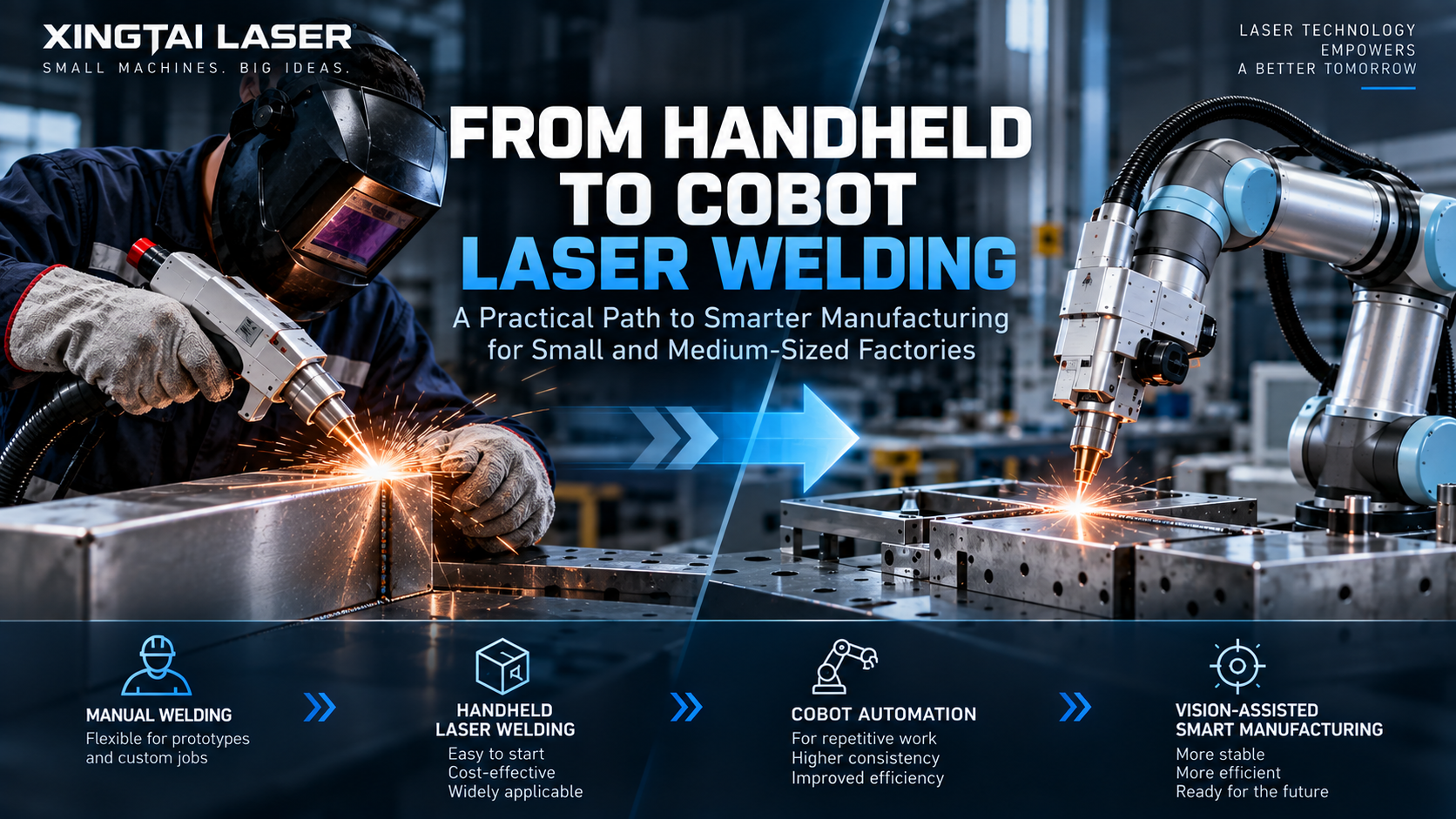
7. The Bigger Trend Is “Start Manual, Automate Later”
This may be the most interesting lesson for small manufacturers.
Historically, companies often thought about automation as a major one-time investment.
Build the robotic cell.
Program everything.
Then start production.
A more gradual model is emerging:
Step 1 — Prove the process manually
Use handheld laser welding to determine whether the material, joint and product are suitable.
Step 2 — Identify repetitive parts
Look at which jobs appear regularly and consume significant operator time.
Step 3 — Standardize the process
Establish repeatable welding parameters and fixtures.
Step 4 — Automate where it makes sense
Move suitable repeat jobs onto a cobot or robotic platform.
This allows manufacturers to introduce automation based on actual production demand instead of trying to predict everything before purchasing their first laser system.
8. Machine Vision Could Become the Next Layer
Once laser welding moves onto robots, another technology becomes increasingly useful:
Machine Vision.
A robot works best when it knows exactly where the part is.
But real manufacturing is not always perfect.
Parts move.
Fixtures vary.
Assemblies may arrive slightly differently.
Vision systems can help automated equipment identify:
part position,
orientation,
features,
and potentially the required processing location.
The machine-vision industry itself continues to move toward faster imaging and more edge-based AI inspection. During this week, new industrial-vision announcements included higher-bandwidth imaging systems and developments aimed at high-speed 3D measurement and electronics inspection. Automate
The long-term direction is therefore increasingly clear:
Laser + Robot + Vision + Software
rather than simply:
Laser + Operator.
9. This Is Part of a Much Bigger Manufacturing Shift
The same trend is appearing beyond welding.
This week's laser-manufacturing developments also included integrated laser/scanner/control packages for machine builders, automated semiconductor laser-processing platforms, and modular femtosecond systems designed around production handling, software and automation rather than the laser source alone. Manufacturing With Light
The message is important:
The laser itself is becoming only one part of the manufacturing system.
The competitive advantage increasingly comes from how easily that laser can be turned into reliable production.
10. What Should a Small Manufacturer Do Today?
Not every company needs a robot.
And not every welding job should be automated.
If your production consists mainly of:
one-off repairs,
constantly changing components,
or very low-volume work,
manual welding may remain the more practical choice.
But if your team repeatedly welds the same products every week, it may be worth asking:
Which parts are repeated most often?
How many hours do operators spend on those welds?
Are the joints consistent enough to fixture?
Can the welding parameters be standardized?
Would automation increase throughput or consistency?
Those questions are much more useful than simply asking:
“Should I buy a robot?”
XINGTAI LASER Weekly Insight
Handheld laser welding helped make laser welding accessible to a much broader group of manufacturers.
The next stage may not be replacing those systems.
It may be building on them.
A small workshop could begin with manual laser welding.
Learn the process.
Develop customers.
Identify repeat orders.
Then automate the jobs that justify automation.
That creates a very different path toward smart manufacturing.
Instead of:
Manual factory → expensive automated factory
the transition becomes:
Manual welding → Handheld laser welding → Cobot laser welding → Vision-assisted automation
And for many small and medium-sized manufacturers, that gradual path may make automation much more practical.