Why Cooling Matters More Than You Think in Fiber Laser Cutting
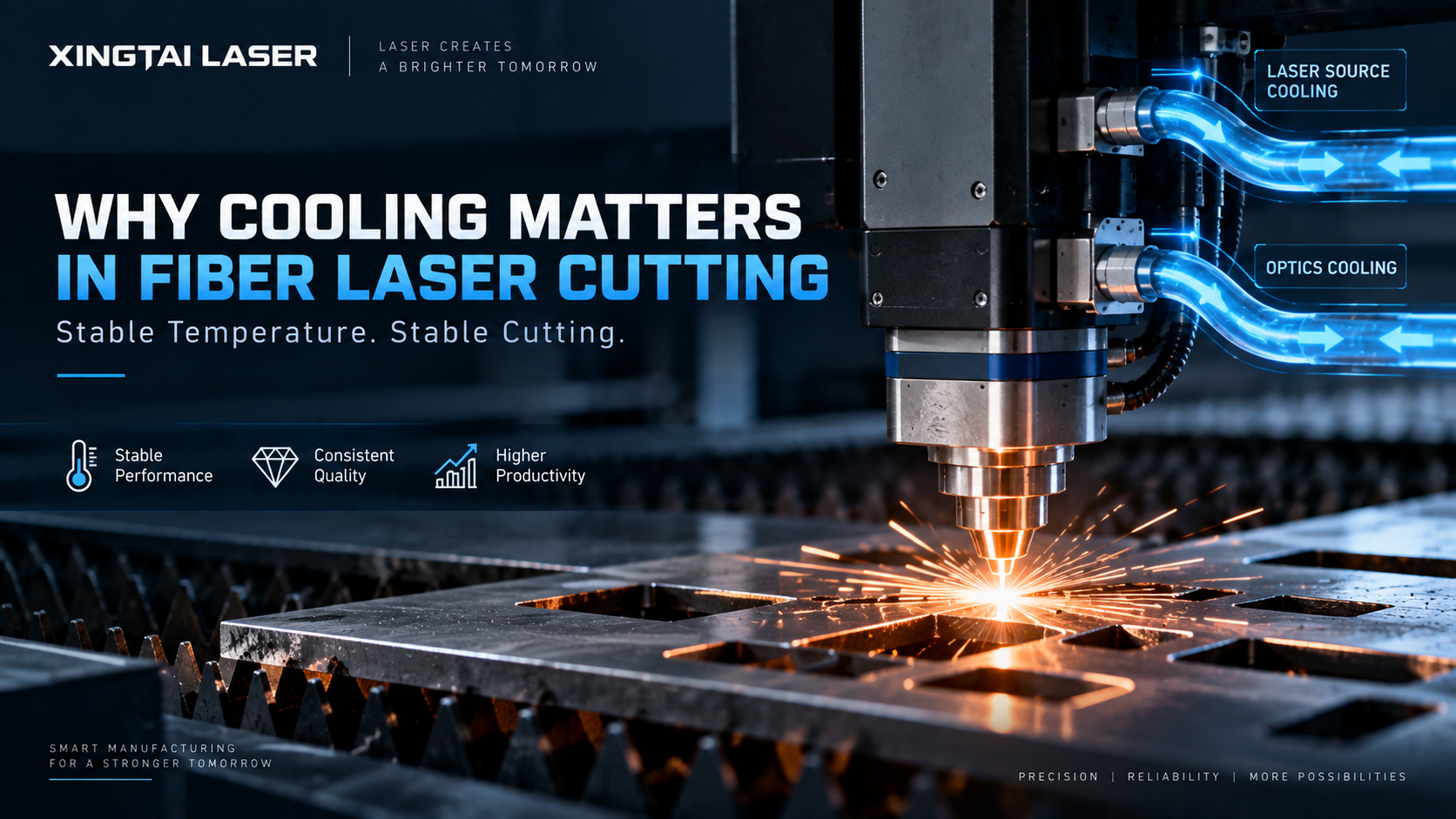
XINGTAI LASER Industry Weekly | September 2026
When buyers compare fiber laser cutting machines, the conversation usually starts with laser power.
1,500W.
3,000W.
6,000W.
12,000W.
Or even higher.
Then they compare the laser source, cutting head, controller, servo system and machine structure.
But one component is often treated as a secondary accessory:
The industrial water chiller.
That is a mistake.
As fiber laser cutting systems become more powerful and factories expect longer continuous operating hours, thermal management is becoming an increasingly important part of machine performance.
Recent developments in industrial laser cooling are making this especially clear.
G&D Chillers recently introduced its Forgeline platform for CO₂ and fiber laser cutting applications. Its dual-zone configuration independently manages cooling for the laser source and optics, while its controls are designed for integration with modern automation platforms.
The message behind this development is simple:
Stable cutting requires stable temperature control.
1. What Actually Gets Hot Inside a Fiber Laser Cutting Machine?
A fiber laser converts electrical energy into laser energy.
But no industrial system converts energy without generating heat.
During continuous cutting, heat accumulates in critical components including the laser source and optical system.
If temperature is not controlled properly, the problem is not simply that the machine “feels hot.”
Temperature variation can affect operating stability and eventually influence cutting consistency.
This is why modern industrial chillers are not simply water tanks with refrigeration units.

They are part of the laser system's thermal-management architecture.
2. Why Modern Fiber Lasers Often Use Two Cooling Circuits
One important development in fiber laser cooling is the use of independent cooling circuits.
The reason is straightforward:
The laser source and optical components do not necessarily have identical thermal requirements.
For example, current S&A/TEYU CWFL systems use separate circuits for the fiber laser source and laser head/optics. Its CWFL-3000 system, designed for 3kW fiber laser applications, specifies dual independent circuits and temperature stability of ±0.5°C.
The concept is similar to controlling two different production zones independently rather than forcing both to operate under one condition.
This gives the machine better thermal control during continuous production.
And as laser power increases, this becomes even more important.
3. Stable Temperature Helps Create Stable Cutting
Consider a factory cutting the same stainless-steel component for several hours.
The operator does not only need the first part to look good.
The 500th part should also meet the same requirement.
That is where production stability becomes important.
Good thermal management helps support:
Stable laser output
Consistent beam conditions
Reliable optical performance
Repeatable cutting quality
Long continuous operation
This is one reason cooling should not be evaluated separately from cutting performance.
The laser source, cutting head and cooling system work together.
4. Higher Laser Power Means Thermal Management Matters More
The fiber laser industry has moved rapidly toward higher power.
But increasing laser power does not simply mean installing a larger laser source.
The surrounding systems must also be able to support that power.
This includes:
power supply,
cutting head,
gas system,
machine structure,
dust extraction,
and cooling.
S&A, for example, now offers cooling systems extending into ultra-high-power fiber laser applications, including systems designed for 40kW and even 60kW lasers. Its 60kW platform uses dual cooling circuits and supports remote monitoring through Modbus communication.
That tells us something important:
As laser power increases, supporting systems become more—not less—important.
A powerful laser source cannot compensate for an unstable machine environment.
5. Cooling Is Becoming Part of Smart Manufacturing
There is another interesting change happening.
Industrial chillers are becoming connected devices.
Modern systems increasingly support communication protocols such as RS-485 Modbus.
Why does this matter?
Because factories want machines that can monitor their own operating conditions.
A connected cooling system can support monitoring of operating status and alarms and can become part of a larger automated production environment. S&A lists RS-485 Modbus on several current fiber-laser cooling platforms, while G&D says its new Forgeline controls are designed for integration with laser and automation systems.
This is part of a larger transition:
Laser machine → Connected manufacturing system
The future of laser manufacturing is not simply higher wattage.
It is better control of the entire production process.
6. Why Condensation Also Matters
Cooling sounds simple:
If something gets hot, make it colder.
But in laser equipment, colder is not always better.
If component temperature falls too far below ambient conditions, condensation can become a risk—particularly in humid environments.
That is why intelligent industrial chillers may adjust temperature according to ambient conditions rather than simply trying to reach the lowest possible temperature.
Current S&A CWFL systems, for example, include intelligent temperature-control modes intended to help manage temperature conditions and reduce condensation risk.
This matters especially for factories operating in hot and humid regions.
Good thermal management means:
Not too hot.
Not unnecessarily cold.
Stable.
7. What Should Buyers Check When Comparing Fiber Laser Cutters?
When evaluating a fiber laser cutting machine, do not ask only:
“What laser source does it use?”
Also ask:
What chiller is included?
Is the cooling capacity correctly matched to the laser power?
Does it independently cool the laser source and optics?
What temperature-control accuracy does it provide?
Does it include water-flow and temperature alarms?
Can the system communicate with the machine controller?
Is the cooling system appropriate for my local climate and electrical supply?
These questions may not sound as exciting as asking about cutting speed.
But after thousands of operating hours, they can become much more important.
8. Do Not Choose a Laser Machine by Wattage Alone
This leads to a broader lesson for equipment buyers.
A fiber laser cutting machine is a system.
Its performance depends on how well its components work together.
A good configuration should balance:
Laser source
Cutting head
Controller
Servo system
Machine structure
Cooling system
Electrical system
Gas system
Software
A machine with the highest laser power is not automatically the best machine.
A properly matched system is usually more valuable than one impressive specification.
9. What This Means for Small and Medium-Sized Manufacturers
For smaller factories, reliability may be even more important.
A large factory may have several production lines.
A small metal workshop may have only one laser cutter.
If that machine stops, production stops.
That means equipment selection should consider more than maximum cutting speed.
The real calculation should include:
Uptime
Maintenance
Operating stability
Consumable cost
Energy consumption
Service availability
and
Long-term production consistency
This is why seemingly “small” components can have a very large effect on the value of a machine.
XINGTAI LASER Weekly Insight
The race toward higher laser power will continue.
But the next stage of competition in laser manufacturing will not be determined by wattage alone.
It will increasingly depend on how intelligently the complete machine is designed.
Cooling is a perfect example.
Customers rarely buy a fiber laser cutting machine because they are excited about its water chiller.
But they may eventually appreciate that chiller every day the machine continues cutting reliably.
So when comparing your next fiber laser cutting machine, remember:
Stable temperature supports stable production.
And stable production is ultimately what manufacturers are buying.