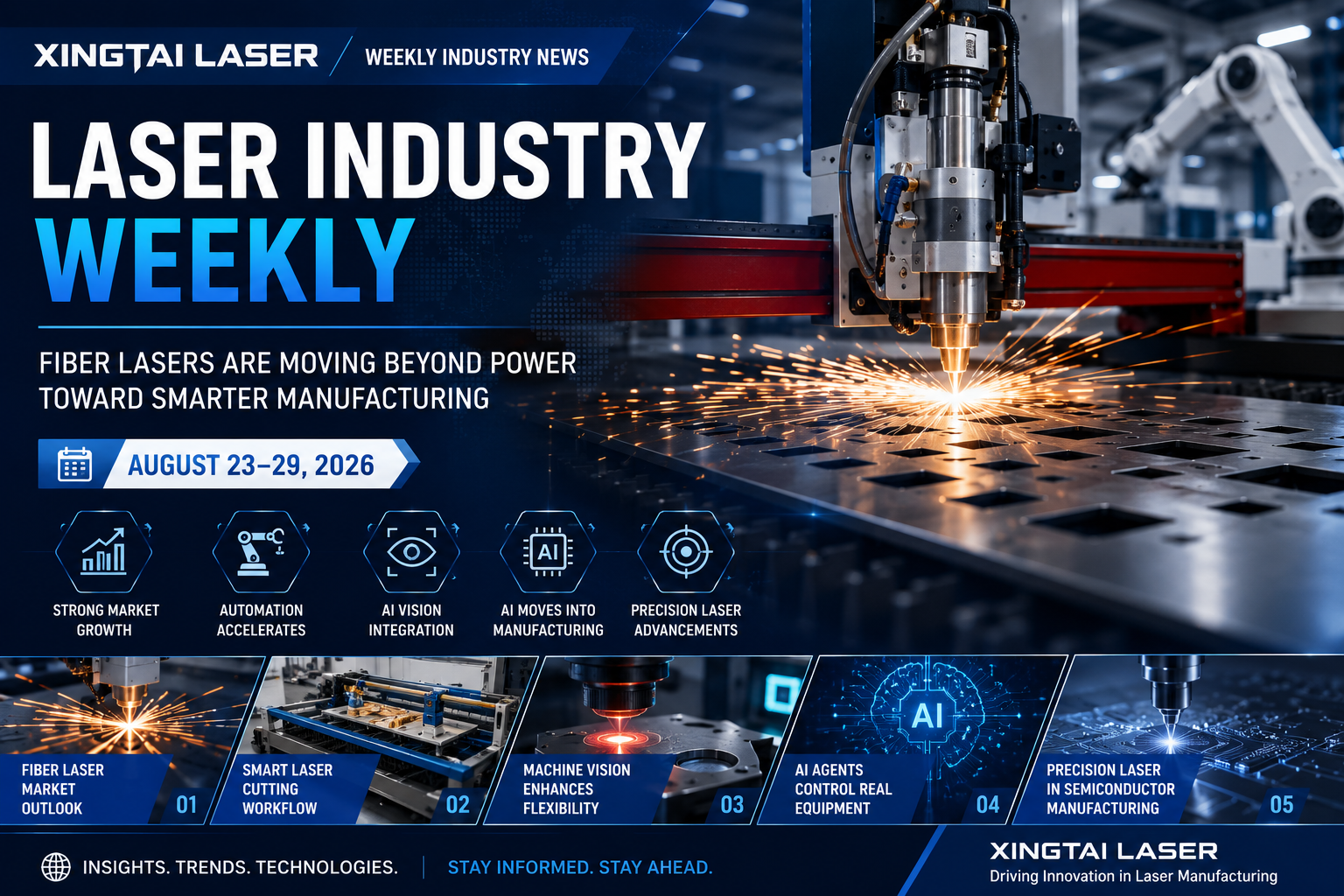
Laser Industry Weekly: Fiber Lasers Are Moving Beyond Power Toward Smarter Manufacturing
For years, one of the first questions buyers asked when comparing laser machines was simple:
“How many watts is it?”
More power usually meant faster processing, thicker cutting capacity, and greater productivity.
That still matters.
But if we look at several developments across the laser and advanced manufacturing industries this week, another trend is becoming increasingly clear:
The future of laser manufacturing is not only about higher power. It is about making the entire production process smarter, more automated, and more flexible.
From fiber laser cutting and welding to machine vision, automated material handling, and even AI-controlled hardware, laser technology is becoming more deeply connected with the broader smart manufacturing ecosystem.
Here are five developments worth watching.
1. Fiber Laser Applications Continue to Expand
Fiber laser technology continues to strengthen its position in industrial manufacturing.
A market outlook published this week highlighted continued growth in demand for double-clad fiber assemblies, an important component used in high-power fiber lasers and amplifiers.
The growth is being driven by applications including:
- Industrial laser cutting
- Laser welding
- Additive manufacturing
- Semiconductor processing
- Precision micromachining
- EV battery manufacturing
The report forecasts that global demand in this segment could grow at a compound annual growth rate of approximately 5.8% through 2035.
For laser machine buyers, however, the percentage itself may not be the most interesting part.
What matters more is where the demand is coming from.
Fiber lasers are no longer associated only with conventional sheet metal cutting or marking.
They are becoming part of a much wider manufacturing ecosystem, from automotive production to electronics and precision engineering.
2. Laser Cutting Is Becoming More About Workflow, Not Just Cutting Speed
Another interesting development this week comes from sheet metal automation.
New fiber laser cutting solutions are increasingly combining:
Laser Cutting + Automatic Material Feeding + CAM Software + Production Monitoring
into one connected workflow.
One recently highlighted automated fiber laser cutting work cell combines a 2 kW fiber laser system with automated coil feeding, allowing different material gauges to be processed with less manual handling. The system also integrates production data, diagnostics, and simulation functions.
This reflects a very practical reality in manufacturing:
A fast laser does not automatically mean a fast factory.
If operators still spend significant time loading material, repositioning sheets, changing jobs, removing parts, and preparing the next production run, improving cutting speed alone only solves part of the problem.
That is why more manufacturers are beginning to think about the complete process:
Material → Software → Cutting → Inspection → Finished Part
instead of asking only:
“How fast can this machine cut?”
For the next generation of laser equipment, workflow efficiency may become just as important as laser power.
3. Machine Vision Is Becoming More Closely Connected With Laser Processing
Another trend worth following is the growing connection between machine vision, AI, and laser processing.
This is particularly relevant to laser marking.
Traditional laser marking normally assumes that a product will be placed in a fixed position.
But real production environments are rarely perfect.
A part may be:
slightly rotated,
a few millimeters away from the expected position,
placed at a different angle,
or mixed together with other components.
If an operator has to manually position every product before marking, productivity quickly becomes limited.
Vision positioning changes this process.
A camera can identify the location and orientation of the workpiece, while software adjusts the marking position accordingly.
This is especially useful in industries such as:
Jewelry, PCB manufacturing, medical devices, precision electronics, and customized production.
The result is more than simply adding a camera to a laser machine.
The machine begins to evolve from:
Laser Machine
into:
Laser + Vision + Software + Automation
And that is an important step toward more flexible manufacturing.
4. AI Is Beginning to Move From Software Into Physical Manufacturing
Perhaps one of the most interesting developments this week comes from outside the traditional laser equipment industry.
On August 27, Anthropic introduced a research preview of its Model Hardware Standard (MHS) framework.
The project explores how AI agents could communicate with and operate programmable laboratory and manufacturing equipment, including devices such as microscopes, robotic arms, and laser-related calibration equipment.
The technology is still at an early stage.
But the direction is worth paying attention to.
Today, many laser processing workflows still look like this:
Operator sets parameters → Loads drawing → Adjusts machine → Processes part → Inspects result → Adjusts parameters again
In the future, some processes could increasingly move toward:
AI analyzes → Machine adjusts → Vision inspects → System corrects → Production continues
This does not necessarily mean operators will disappear.
A more realistic possibility is that the operator's role gradually changes.
Instead of constantly adjusting individual machine parameters, operators may spend more time supervising and managing intelligent production systems.
That could become one of the most important changes in smart manufacturing over the coming years.
5. Precision Laser Processing Is Moving Deeper Into Semiconductor Manufacturing
Laser technology is also continuing to expand into extremely high-precision applications.
This week, E&R Engineering announced new laser processing technologies ahead of SEMICON Taiwan 2026, including applications involving fiber array units, glass cores, and through-glass vias.
One highlighted five-axis laser drilling application claims positioning accuracy down to approximately ±0.5 μm.
This is obviously very different from cutting a steel plate in a fabrication workshop.
But it demonstrates just how broad laser manufacturing has become.
At one end of the industry, high-power fiber lasers cut thick metal plates.
At the other, precision laser systems process microscopic structures for advanced electronics and semiconductor applications.
The machines may be completely different, but several advantages remain the same:
Non-contact processing.
Digital control.
High precision.
Easy integration with automation.
These characteristics are one reason laser technology continues to enter new manufacturing industries.
What Does This Mean for Small Manufacturers?
When people hear terms such as:
AI Manufacturing, Machine Vision, Automation, Smart Factory
they often imagine huge automotive factories and multimillion-dollar production lines.
But there is another trend happening at the same time.
Technologies that were once mainly available to large factories are gradually becoming available in smaller machines.
A jewelry workshop can now use vision positioning for laser marking.
A small metal fabrication company can bring certain cutting jobs in-house with a compact fiber laser cutter.
A customized product manufacturer can use fiber laser marking for logos, serial numbers, identification codes, and personalization.
A small workshop can introduce handheld laser welding without immediately investing in a fully automated welding line.
This is an important shift.
Smart manufacturing does not always have to begin with a massive automated factory.
Sometimes, it starts with one smarter machine.
Laser Power Still Matters — But It Is No Longer the Whole Story
None of this means laser power is becoming unimportant.
It still matters.
An 800W, 1200W, and 1500W fiber laser cutter will not have exactly the same cutting capability.
A 20W fiber marking laser and a 100W system are designed for different processing requirements.
A 1500W handheld laser welder and a 3000W system also serve different applications.
But wattage should increasingly become only one part of the buying decision.
Manufacturers should also ask:
How easy is the machine to operate?
Can vision positioning be integrated?
Can the system connect with automation later?
Can software reduce repetitive operator work?
Can the machine adapt as production requirements change?
These questions may become just as important as asking:
“How many watts does it have?”
From Bigger Machines to Smarter Machines
From our perspective at XINGTAI LASER, the direction of the industry is becoming increasingly clear:
More compact equipment. Smarter control. Easier operation. More flexible production.
Large industrial laser machines will continue to dominate high-volume manufacturing.
That will not change.
But between traditional manual manufacturing and fully automated industrial factories, there is a large and growing space for small and medium-sized smart manufacturing.
This is where equipment such as:
- Desktop fiber laser cutting machines
- Vision positioning laser marking machines
- Portable laser marking systems
- Handheld laser welding machines
- Compact laser cleaning machines
can play an increasingly important role.
Their purpose is not necessarily to replace a large industrial production line.
Their value is giving smaller manufacturers access to digital laser processing without requiring them to build a large factory first.
Final Thoughts
After looking at this week's developments, one change stands out.
For many years, competition in the laser industry was heavily focused on one question:
“Who has more power?”
Over the next few years, another question may become increasingly important:
“Whose machine is smarter?”
Laser power determines what a machine is capable of processing.
But software, machine vision, automation, and AI are increasingly determining how efficiently that machine can become part of a real production process.
And that may be where the next major transformation in laser manufacturing begins.
XINGTAI LASER | Weekly Laser Industry Insights
We continue to follow developments in:
Fiber Laser Cutting | Laser Marking | Laser Welding | Laser Cleaning | Machine Vision | Automation | Smart Manufacturing
Because the next machine that changes the way a factory works may not necessarily be a bigger machine.
It may simply be a smarter one.
XINGTAI LASER
WhatsApp: +86 18722099531
Email: rachel@tjxtmachine.com
XINGTAI LASER Website