XT-4040 800W vs 1200W vs 1500W: Which Fiber Laser Power Should You Choose?
The Machine Is the Same. The Real Difference Is How Much Cutting Power You Actually Need.
One of the first questions customers ask us about the XT-4040 Desktop Fiber Laser Cutting Machine is:
“Should I choose 800W, 1200W, or 1500W?”
It sounds like a simple question.
But choosing laser power is not about buying the biggest number you can afford.
The right choice depends on what you actually want to cut.
What material?
What thickness?
How often?
And what kind of cutting quality do you expect?
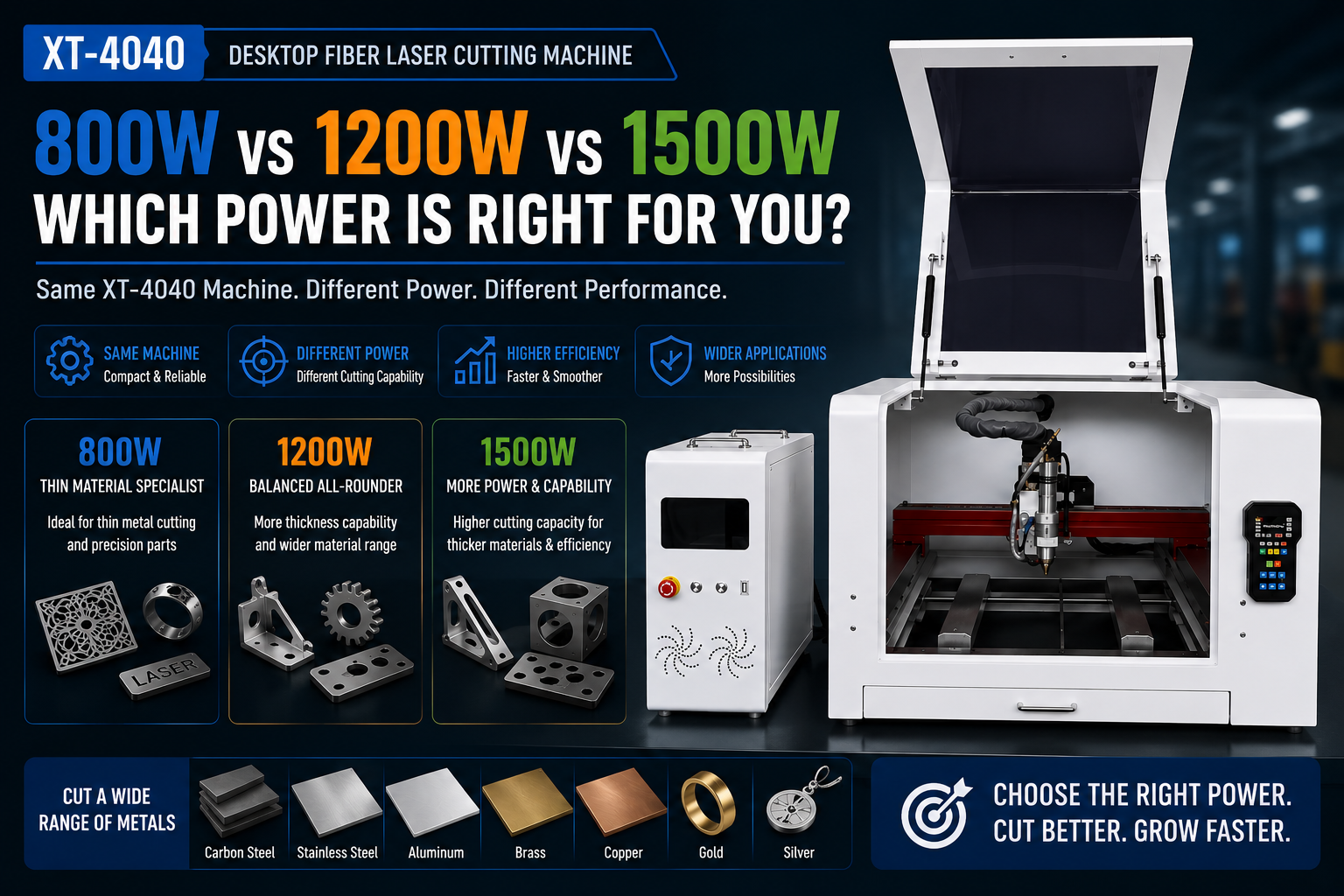
For the XT-4040, the 800W, 1200W and 1500W versions are based on the same compact machine concept.
The main difference is the laser power.
And that difference directly affects:
- Recommended production thickness;
- Maximum practical cutting thickness;
- Cutting speed;
- Cutting stability;
- Performance on highly reflective metals;
- Production efficiency.
So instead of asking:
“Which power is better?”
A better question is:
“Which power matches my products?”
Let's look at the differences.
First: What Does Higher Laser Power Actually Change?
A common misunderstanding is that a 1500W machine is somehow a completely different machine from an 800W version.
For the XT-4040, that is not the point.
The working concept remains essentially the same.
What changes is the amount of laser energy available for cutting.
More power generally means the machine can:
cut thicker material, cut the same thickness more efficiently, and provide more processing headroom.
But that does not automatically mean every customer should buy 1500W.
If your business mainly processes thin jewelry components, nameplates, small stainless steel parts, or prototypes, 800W may already cover your normal production.
Paying for unused power does not necessarily make your business more profitable.
800W: A Practical Starting Point for Thin Metal Processing
The 800W XT-4040 is the most entry-level option of the three.
Its strength is not maximum thickness.
Its strength is providing a practical entry into fiber laser cutting for businesses mainly working with thinner materials.
Based on our reference cutting parameters:
| Material | Recommended Production Thickness | Standard Maximum* | Reference Limit* |
|---|---|---|---|
| Carbon Steel | 1.0–2.5 mm | 4.0 mm | 8.0 mm |
| Stainless Steel | 0.5–2.0 mm | 3.0 mm | 6.0 mm |
| Aluminum | 0.5–1.0 mm | 2.0 mm | 3.5 mm |
| Brass | 0.5–0.8 mm | 1.5 mm | 3.0 mm |
| Copper | 0.3–0.5 mm | 1.0 mm | 1.5 mm |
| Gold | 0.2–0.5 mm | 0.8 mm | 1.5 mm |
| Silver | 0.2–0.5 mm | 0.8 mm | 1.5 mm |
Who should consider 800W?
800W makes sense if you mainly produce:
- Thin stainless steel parts;
- Jewelry components;
- Metal nameplates;
- Small hardware parts;
- Prototype components;
- Decorative metal products;
- Thin precious-metal components.
For these applications, there may be little reason to pay for significantly more power if thicker cutting is rarely required.
1200W: The More Balanced Choice
If a customer asks me which configuration gives the best balance between investment and cutting capability, 1200W is usually the configuration worth looking at very carefully.
Why?
Because compared with 800W, it gives noticeably more cutting capacity without completely changing the positioning of the machine.
According to the reference data:
| Material | Recommended Production Thickness | Standard Maximum* | Reference Limit* |
|---|---|---|---|
| Carbon Steel | 0–4.0 mm | 8.0 mm | 10.0 mm |
| Stainless Steel | 0–4.0 mm | 5.0 mm | 8.0 mm |
| Aluminum | 0–2.0 mm | 4.0 mm | 4.0 mm |
| Brass | 0–1.5 mm | 3.0 mm | 3.5 mm |
| Copper | 0–1.0 mm | 2.0 mm | 2.5 mm |
| Gold | 0–1.0 mm | 1.5 mm | 2.0 mm |
| Silver | 0–1.0 mm | 1.5 mm | 2.0 mm |
This is a meaningful step up from 800W.
For example, a business that currently cuts thin stainless steel may later receive orders for thicker brackets or hardware components.
With 1200W, there is more room for those future jobs.
Who should consider 1200W?
It is particularly suitable for:
- Small metal fabrication businesses;
- Hardware manufacturers;
- Custom product manufacturers;
- Automotive modification workshops;
- Sign-making businesses;
- Prototype workshops;
- Businesses processing several different metals.
If your work is not limited to ultra-thin materials, 1200W is a very versatile middle-ground option.
1500W: More Cutting Capacity and More Production Headroom
Then we come to 1500W.
The biggest reason to choose 1500W is simple:
You need more cutting capability.
According to the reference cutting parameters:
| Material | Recommended Production Thickness | Standard Maximum* | Reference Limit* |
|---|---|---|---|
| Carbon Steel | 1.0–4.0 mm | 6.0 mm | 10.0 mm |
| Stainless Steel | 0.5–3.0 mm | 4.0 mm | 6.0 mm |
| Aluminum | 0.5–2.0 mm | 3.0 mm | 4.0 mm |
| Brass | 0.5–1.5 mm | 2.0 mm | 3.0 mm |
| Copper | 0.3–1.0 mm | 1.5 mm | 2.0 mm |
| Gold | 0.2–0.8 mm | 1.0 mm | 1.5 mm |
| Silver | 0.2–0.8 mm | 1.0 mm | 1.5 mm |
But there is something important here.
Do not read these tables as a simple “higher wattage always equals a higher number in every column.”
Cutting tables depend heavily on how the test is defined: speed, acceptable edge quality, gas, pressure, optical configuration, material condition and parameter tuning all matter.
That is why the recommended production range is often more useful than chasing an “ultimate maximum thickness.”
For a real business, the important question is not:
“Can the machine cut this thickness once?”
It is:
“Can it cut my normal material repeatedly, efficiently and with the quality I need?”
That is a much more useful way to choose power.
800W vs 1200W vs 1500W at a Glance
The easiest way to understand the three configurations is this:
800W — Thin Material Specialist
Choose it when:
Your materials are relatively thin.
Your production volume is moderate.
You want to control initial investment.
Your applications include jewelry, prototypes, thin hardware or customized metal products.
Main advantage: Lower entry cost.
1200W — Balanced All-Rounder
Choose it when:
You process several different metals.
You need more thickness capability.
Your business may expand in the future.
You want a balance between price and performance.
Main advantage: Versatility.
1500W — More Power and Production Headroom
Choose it when:
Your materials are regularly thicker.
Cutting efficiency matters more.
You want more power reserve.
You expect the machine to handle a wider range of future orders.
Main advantage: Greater processing capability.
Don't Choose Power Based Only on Maximum Thickness
This is probably the most important point in this article.
Suppose someone tells you:
“This machine can cut 10 mm carbon steel.”
That number alone does not tell you enough.
You still need to ask:
At what speed?
Using what gas?
What edge quality?
Can it be used for continuous production?
Is this the recommended thickness or an extreme test condition?
There is a big difference between:
“It can cut it.”
and
“It is suitable for producing it every day.”
That is why our parameter tables distinguish between recommended production thickness, standard maximum thickness, and reference/ultimate limits.
For most buyers, I recommend paying the most attention to the first category.
Assist Gas Matters Too
Laser power is only part of the cutting process.
Different metals require different gas strategies.
For example:
Carbon Steel
Oxygen (O₂) is commonly used because the oxidation reaction contributes additional heat to the cutting process.
Stainless Steel
High-pressure nitrogen (N₂) is commonly used when a clean, bright, oxidation-free edge is required.
Aluminum
Nitrogen or suitable compressed air may be used depending on the required finish and application.
Brass
High-pressure nitrogen is commonly used to help achieve a clean cutting edge.
Copper
Copper is highly reflective and thermally conductive, making it more demanding to process. Appropriate laser configuration and cutting parameters are especially important.
Gold and Silver
These materials are usually associated with thin, precision applications such as jewelry manufacturing, where minimizing oxidation, discoloration and material loss can be more important than cutting maximum thickness.
So when choosing a machine, do not only tell your supplier:
“I want 1200W.”
Tell them:
“I cut 1 mm silver jewelry parts.”
or
“I mainly cut 3 mm stainless steel brackets.”
That information is far more useful.
A Jewelry Workshop and a Hardware Factory Should Not Choose the Same Way
Imagine two customers.
Customer A: Jewelry Workshop
They mainly cut:
- 0.3 mm gold;
- 0.5 mm silver;
- Thin stainless steel jewelry parts.
Their priority is:
Precision.
Material utilization.
Fine details.
Small-batch customization.
For them, 800W may already be a very practical choice.
Customer B: Hardware Manufacturer
They regularly cut:
- 2–3 mm stainless steel;
- Carbon steel brackets;
- Aluminum components;
- Customized mechanical parts.
They also expect their production range to grow.
For this customer, 1200W or 1500W may make much more sense.
Same XT-4040 platform.
Completely different power decision.
Should I Just Buy 1500W to Be Safe?
We hear this question quite often.
There is nothing wrong with choosing more power if your budget allows and you genuinely expect to use the additional capacity.
But I would not recommend selecting laser power purely based on:
“Bigger must be better.”
The goal is not to buy the highest number.
The goal is to buy a machine that makes money for your business.
If 90% of your work is 0.5 mm jewelry components, then your decision should be based on that 90% of real production—not on a hypothetical thick plate you might cut once in the future.
On the other hand, if your business is growing quickly and thicker products are already appearing in customer inquiries, choosing additional power now may save you from upgrading too soon.
How We Recommend Choosing Your XT-4040 Power
Before recommending 800W, 1200W or 1500W, we prefer to know five things:
1. What material do you cut?
2. What is your normal thickness?
Not the thickest material you might possibly encounter. Your normal production thickness.
3. What is the maximum thickness you really need?
4. What products are you making?
Jewelry, brackets, signs, automotive parts and precision components have very different priorities.
5. How much do you produce?
A prototype workshop and a business running repeated production orders should not necessarily choose the same configuration.
Once these questions are clear, selecting power becomes much easier.
Final Comparison: Which XT-4040 Should You Choose?
If I had to simplify the decision into three sentences:
Choose 800W if your business mainly processes thin materials and you want the lowest practical entry point.
Choose 1200W if you want a balanced configuration with more flexibility across materials and thicknesses.
Choose 1500W if you need greater cutting capability, efficiency and more room for future production requirements.
But don't buy based on wattage alone.
Buy based on what you actually make.
That is the difference between buying a machine with impressive specifications and buying a machine that actually fits your business.
Not Sure Whether You Need 800W, 1200W or 1500W?
You don't need to guess.
Send us:
- Material;
- Normal thickness;
- Maximum thickness;
- Product photo or drawing;
- Expected production volume.
We can evaluate your application and recommend a suitable XT-4040 configuration.
If possible, sending an actual sample or drawing is even better.
Because in laser cutting, a real cutting test is more useful than arguing about numbers on a specification sheet.
XINGTAI LASER
WhatsApp: +86 18722099531
Email: rachel@tjxtmachine.com