Deep Laser Welding Reaches 14 cm: What the Research Means for Industrial Buyers
XINGTAI LASER | Industry News Analysis | November 15, 2026
Why this news matters
On November 9, 2026, TRUMPF announced that it and research partners including RWTH Aachen University had achieved a reported 14-centimeter welding depth in steel in a single operation using laser welding in a vacuum (LaVa). The company contrasted the result with a previously reported 6-centimeter benchmark for comparable laser processes. This is a research announcement about a specific process, not a specification for a commercially available handheld or conventional laser welding machine.
What was actually reported
According to TRUMPF's release, the work demonstrates the potential of high-power laser processing under vacuum conditions for very thick structures. TRUMPF cited possible future relevance to sectors such as wind energy and shipbuilding. Those applications are prospective opportunities, not evidence that any particular production line can immediately reproduce the laboratory result. The reported penetration depth should not be interpreted as a universal material thickness rating.

Why the process environment matters
Laser power alone does not determine achievable penetration or weld quality. The material grade, joint geometry, fit-up, beam delivery, travel speed, vacuum environment, thermal behavior and process stability all influence the result. A laboratory demonstration can establish technical feasibility while leaving important engineering questions about repeatability, throughput, maintenance and total operating cost open. A buyer should request the exact test conditions before comparing results across processes.

Penetration is not the same as an accepted weld
A deep fusion zone is only one part of a welding qualification. Depending on the application, acceptance may also require testing for porosity, cracking, mechanical performance, distortion and consistency along the full joint. Inspection methods should be selected against the relevant engineering specification. A photograph or a headline penetration figure cannot replace documented weld qualification and testing.
Research breakthrough versus workshop equipment
Most small and medium-sized workshops face different requirements from heavy-section structural manufacturing. They may need repeatable joints in relatively thin stainless steel, aluminum or other suitable materials, with manageable fixtures, shielding, operator training and after-sales support. A highly specialized vacuum process should not be compared directly with a conventional laser welder solely on wattage or claimed depth. The correct comparison begins with the actual part and acceptance criteria.
Five questions buyers should ask
First, what exact material grade and joint thickness were tested? Second, what joint preparation and gap tolerances are required? Third, which process conditions—including vacuum, laser source and travel speed—are essential? Fourth, what inspection and mechanical test evidence supports the claim? Fifth, can the supplier demonstrate repeatable production on the buyer's own samples, including cycle time and running costs? Written answers are more useful than a single impressive demonstration.

What this means for XINGTAI LASER customers
XINGTAI LASER supplies laser equipment for different manufacturing applications, but this article does not claim that any XINGTAI model performs 14-centimeter deep welding, uses LaVa technology or offers vacuum welding as standard. Product suitability must be confirmed against the specific machine configuration and an application test. Customers seeking welding equipment should share material type, thickness, joint photographs, production volume and required weld quality before a recommendation is made.
The broader takeaway
The November 9 announcement is a useful example of how industrial laser research can expand the boundaries of feasible processes. For purchasing decisions, however, the important question is not whether a record was achieved somewhere, but whether a proposed machine can deliver a documented, repeatable and economically sensible result for the buyer's own workpieces.
Source and editorial note
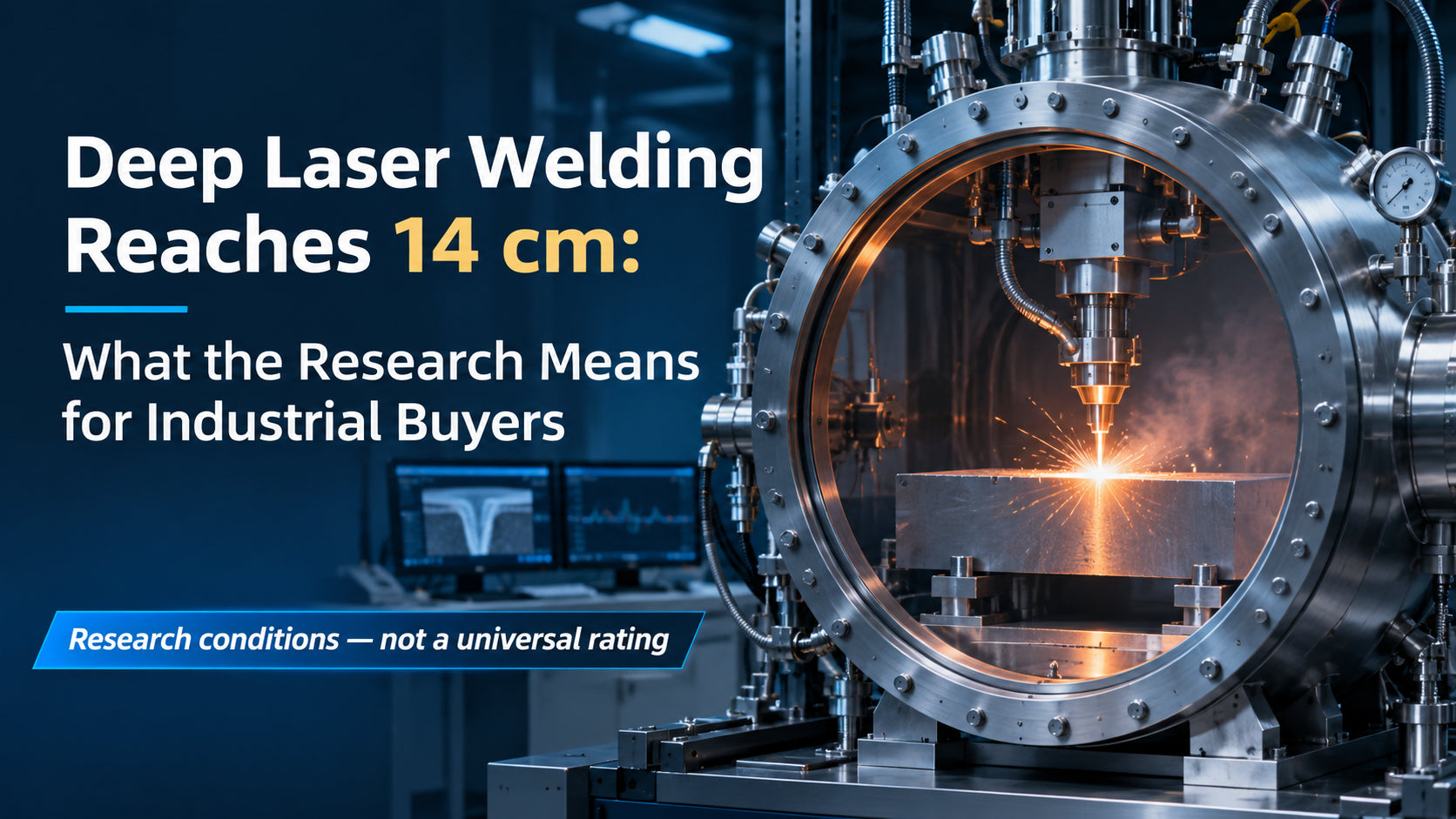
Primary source: TRUMPF, November 9, 2026, 'World Record with a High-Power Laser: TRUMPF Speeds Up the Welding of Thick Steel Components.' The 14-centimeter figure and stated potential applications are attributed to the manufacturer's announcement; the buyer evaluation framework above is XINGTAI LASER editorial analysis. Any accompanying illustrations are conceptual and are not photographs of the research apparatus or XINGTAI products.
-
Posted in
Industry News, Laser Manufacturing, Laser Welding