Black Laser Marking vs. Deep Engraving on Stainless Steel: Which Finish Should You Specify?
XINGTAI LASER | Practical Application Guide | November 11, 2026
Why the distinction matters
A buyer may ask for a “permanent black laser engraving” on a stainless-steel plate. That phrase combines two different outcomes: a dark surface mark and a recessed engraving. Both can be useful, but they are not interchangeable. The right choice depends on appearance, surface condition, wear exposure, readability and the time available per part. This is an application guide, not an announcement of a new XINGTAI LASER machine or a claim that one configuration achieves every finish.
1. Define black marking and deep engraving
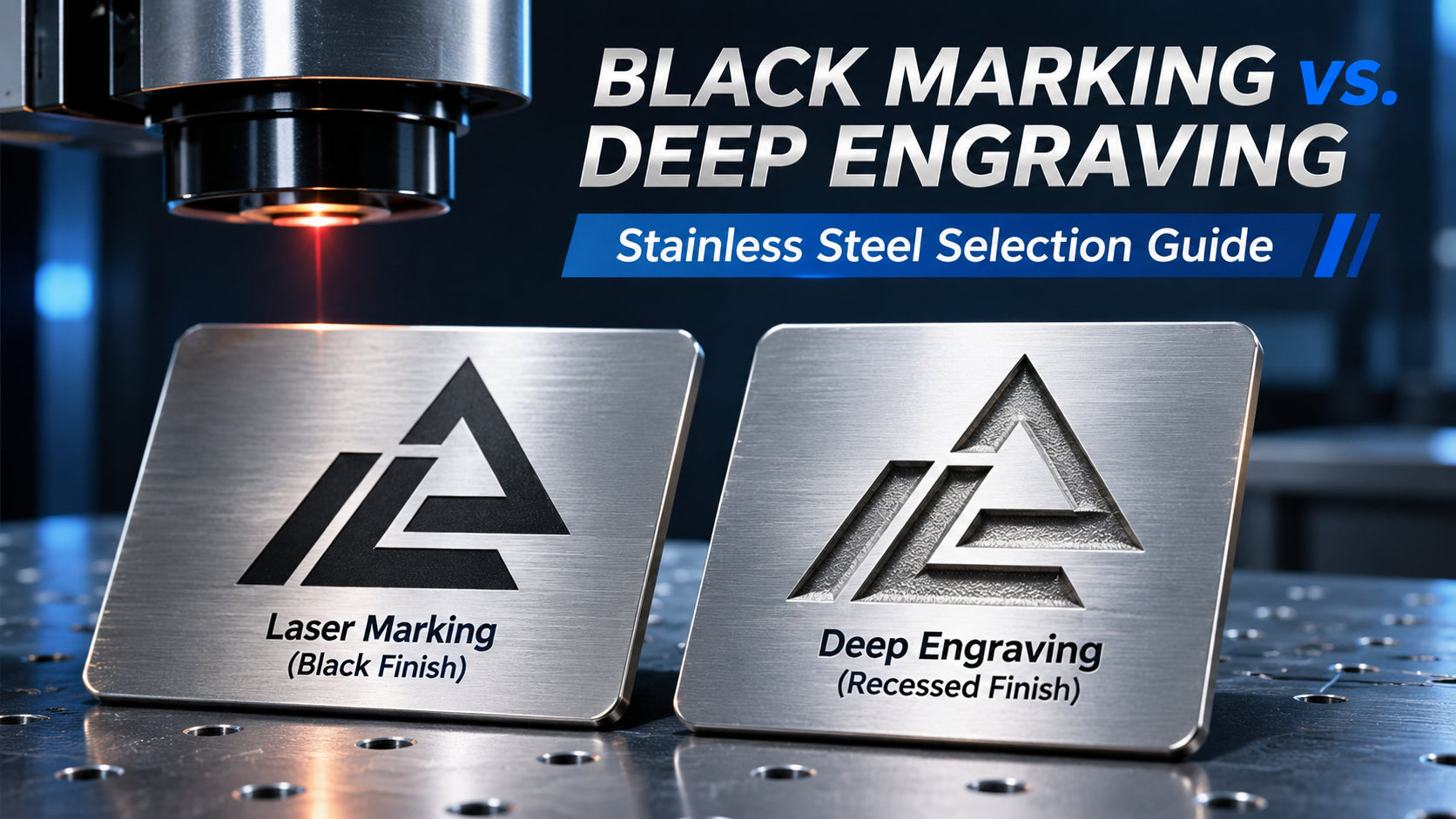
Black laser marking aims to produce visible dark contrast on the surface, often through a controlled change in the surface or oxide layer. The exact mechanism and appearance depend on stainless-steel grade, surface finish, laser source, pulse behavior and process settings. Deep engraving deliberately removes material to create a measurable recess. It may require multiple passes and debris management. A dark-looking engraving is not automatically deep, and a visually black mark is not automatically resistant to abrasion or corrosion.
2. Compare the outcome, not just the wattage
For a product label or readable serial number, strong contrast and a smooth finish may matter more than depth. For a tool identification plate exposed to repeated abrasion, an engraved recess may be preferable, but the depth, character geometry and subsequent finishing must be tested. The requirement should be written as a measurable acceptance criterion, not simply “high power” or “permanent.”
3. Start with the actual stainless steel
304 and 316 stainless steel can differ in their marking response; even parts of the same grade may behave differently after brushing, polishing, passivation or coating. A sample on an untreated coupon does not prove the result on a finished production part. Send the supplier the exact grade, thickness, surface finish and photographs of the intended area. The first sample should reproduce the production surface as closely as possible.

4. Understand the trade-off between appearance and depth
Surface marking may preserve the original geometry more closely, but color and durability vary with the process. Deep engraving creates a physical feature, yet excessive removal can introduce rough edges, burrs or unacceptable changes to a thin component. Neither method guarantees a particular corrosion-resistance result. If the component is exposed to cleaning chemicals, outdoor weather or repeated rubbing, define a representative test before approving production.

5. Specify readability and inspection
For a Data Matrix code, a photograph is not sufficient evidence of production readability. Agree on the code size, module dimensions, scanner, lighting, verification method and acceptance grade where applicable. For ordinary text or logos, check contrast, line width, edge definition and appearance from the real viewing distance. Use several samples rather than judging one attractive demonstration piece.

6. Compare cycle time and total cost
A deep engraving may need additional passes and can take longer than a surface mark of similar size, but actual time depends on depth, pattern, material and settings. Record accepted parts per hour, rework rate, consumables, cleaning needs and operator handling. A faster-looking process is not necessarily cheaper if marks fail the final inspection.
7. Request a controlled sample trial
Provide the actual part or representative material, artwork in a suitable vector format, required marking area, target depth if applicable, desired contrast, anticipated annual volume and expected service conditions. Ask for close-up photos, a short process video, measured cycle time and agreed inspection results. If depth matters, request an appropriate measurement rather than relying on shadows in a photo.
What to ask XINGTAI LASER
XINGTAI LASER offers fiber laser marking equipment with configurations that vary by application. For a stainless-steel project, share the material grade, surface condition, design, required finish and production target before choosing a machine or laser source. Whether a particular black-marking effect or engraving depth is achievable must be confirmed by sample testing on the specified material and machine configuration.
Frequently asked questions
Is black laser marking the same as deep engraving? No. A dark surface mark and a recessed material-removal process describe different results.
Will black marking always remain black after abrasion? No. Resistance depends on the material, process and exposure; test the actual application.
Is deeper always better? No. Unnecessary depth can increase cycle time and affect a thin or precision part.
Can I choose the machine by wattage alone? No. The laser source, pulse characteristics, optics, material and acceptance criteria all matter.
Conclusion
The best specification begins with the finished part: should the mark be dark, physically recessed, highly readable, resistant to a defined wear test, or some combination? Agree on the outcome, test the real material and evaluate repeatability before committing to production. That is a more dependable purchasing process than choosing by advertised wattage alone.
Editorial transparency: This is an application guide. It does not report a newly released product or claim independent laboratory certification. Illustrations are conceptual and not documented production test results.
-
Posted in
application guide, deep engraving, fiber laser, laser marking, stainless steel