Laser Welding Automation: When Does Vision Guidance Actually Improve Repeatability?
XINGTAI LASER | Application Guide | November 8, 2026
Laser Welding Automation: When Does Vision Guidance Actually Improve Repeatability?
Why this guide, rather than a breaking-news headline?
A review of laser-manufacturing coverage available on November 8, 2026 did not yield a sufficiently well-sourced, distinct announcement from the previous seven days for this article. Instead of presenting an old announcement as new, this guide explains a practical purchasing question: when does camera-assisted positioning help a laser-welding workflow, and when is a simple, well-designed fixture enough? This is an application guide, not an announcement of a XINGTAI LASER product feature.
1. Separate three different functions
Vision positioning, seam tracking and post-weld inspection are not interchangeable. A positioning camera can help locate a part before welding. Seam tracking uses sensing and motion control to respond to the joint path during the operation. Inspection checks a completed weld against defined criteria. A supplier offering one function should not automatically be assumed to provide all three.
2. Begin with the joint and the fixture
Before considering cameras or AI, define the material, thickness, joint geometry, gap tolerance, required appearance and production volume. A rigid fixture that consistently presents the joint can reduce variation at relatively low complexity. A camera cannot compensate for uncontrolled fit-up, excessive gaps or poor preparation. The first practical question is whether part-to-part variation is large enough to justify sensing.
3. Decide what the camera must measure
For part location, define which edges, holes or fiducials remain visible after clamping. For seam tracking, define the joint contrast, reflections, travel path and acceptable positional error. Highly reflective metal, spatter and changing illumination can challenge image acquisition. A sample test should include worst-case parts, not only ideal demonstration samples. A vision system should be evaluated on its measured positioning accuracy and failure handling, not on a promotional screenshot.

4. Treat welding parameters and inspection separately
A visually centered weld path does not establish adequate penetration, strength or absence of internal defects. The process still needs qualified settings for the specific material and joint, suitable shielding where required, controlled heat input and an acceptance method. Surface photographs may help identify certain visible issues, but they cannot replace destructive testing or other required inspections. A green pass indicator on a screen is meaningful only when its acceptance criteria and validation are documented.

5. Calculate the value for a small workshop
A camera-assisted cell can introduce additional hardware, integration, calibration, training and maintenance costs. Its value depends on reduced rework, faster setup, more consistent placement or higher utilization in the buyer's real workflow. Compare the full cycle time: loading, clamping, locating, welding, checking and unloading. For short runs with stable fixtures, a simpler setup may be more economical than a complex automated cell.
6. Run a controlled acceptance trial
Ask the supplier to test representative parts across multiple batches and operators. Record alignment deviation, cycle time, reject rate, operator intervention and restart behavior after a failed detection. Include an intentional misloaded part to verify that the system stops or flags the condition as specified. Document what happens when the camera cannot find the seam. Repeatability should be demonstrated with measured results rather than inferred from a video.

7. Questions to ask before purchasing
Request a clear list of included and optional functions: camera positioning, seam tracking, closed-loop control, weld monitoring, data logging and inspection. Confirm machine model compatibility, fixture requirements, software licenses, spare parts, service and operator training. If the seller describes an AI feature, ask which decision it makes, what data supports it and how its performance was validated.
What XINGTAI LASER buyers should know
XINGTAI LASER supplies laser equipment for different manufacturing applications, including welding and marking. However, this guide does not claim that a particular XINGTAI welding machine includes a vision camera, seam-tracking system, robotic arm or AI inspection. Those functions require a model-specific written configuration and an application test. Share the workpiece material, thickness, joint photos, sample quantity and production target so the equipment and process can be assessed without unsupported promises.
Conclusion
Vision guidance can be useful when it solves a documented positioning problem. It is not a substitute for good fixtures, qualified welding parameters or inspection. For small manufacturers, the best investment is the least complex process that repeatedly meets the part's acceptance requirements.
Editorial transparency
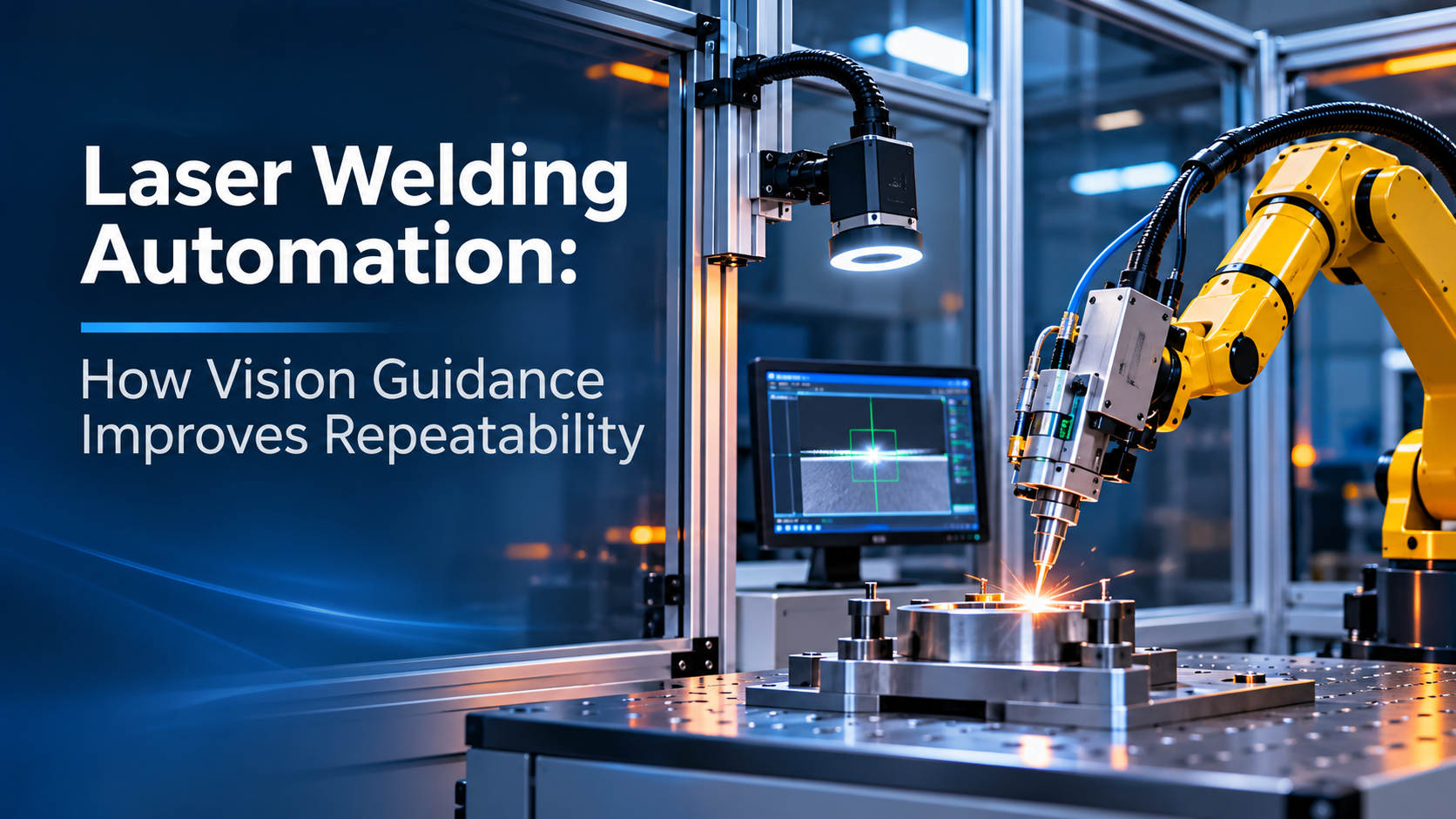
Published as a practical technical guide prepared November 8, 2026. The robotic cells shown in accompanying conceptual illustrations are not photographs of a specified XINGTAI LASER machine. No recent news announcement is claimed, and no product performance figures are asserted.
-
Posted in
Application Guide, Automation, Laser Welding, Machine Vision