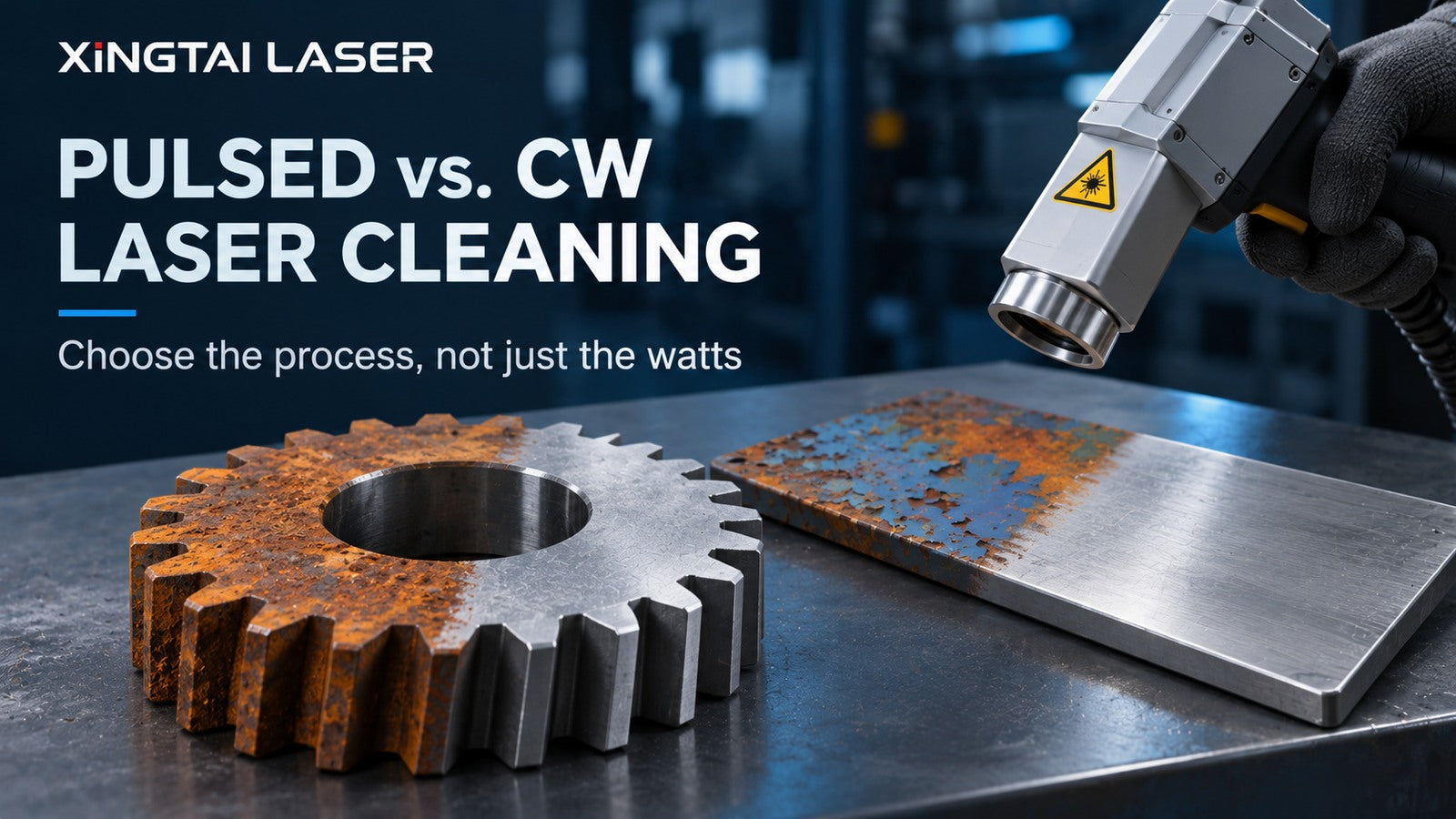
Pulsed vs. CW Laser Cleaning: Key Differences in Speed, Heat & Surface Quality
Tjxtmachine | Application Guide | November 2, 2026
When a workshop asks for a laser cleaning machine, the first question is often, “How many watts do I need?” A more useful starting point is what must be removed—and what must remain unchanged. Removing loose rust from a heavy steel frame is a different job from cleaning a precision mold, a thin stainless steel panel or a part that will be painted afterward.
Two common approaches are pulsed laser cleaning and continuous-wave (CW) laser cleaning. Both can remove selected surface layers, but they deliver energy differently. That difference can affect heat input, cleaning speed, surface appearance and the risk of altering the underlying material.
This article is a practical application guide, not an announcement of a new laser model. It explains how a small manufacturer can compare the two processes using real workpieces and measurable acceptance criteria.
What Is the Difference Between Pulsed and CW Laser Cleaning?
A pulsed laser releases energy in short bursts. The pulse duration, repetition rate, average power, beam characteristics and scanning parameters all influence how the surface responds. In suitable applications, controlled pulses can remove a contaminant layer while limiting unwanted heat accumulation in the substrate.
A CW laser emits energy continuously while the beam is operating. It can be useful for some larger-area, robust-metal cleaning tasks, but excessive dwell time or inappropriate settings can increase heat input and change the substrate surface.
Neither method is automatically damage-free or universally faster. Material absorption, coating thickness, beam size, scan speed, overlap and the required finish must all be considered. The label “pulsed” alone does not guarantee a clean result, just as “CW” does not mean every part will be damaged.
1. Start With the Contamination, Not the Laser Power
Rust, oxide, paint, grease and production residues do not respond identically to laser energy. A thin oxide film on a machined part may require a very different process from thick paint on a large structural component.
Before requesting a quotation, identify the contaminant, its approximate thickness and the area that must be cleaned. Explain whether the goal is cosmetic restoration, preparation for coating, maintenance, or a controlled manufacturing process.
The right cleaning process depends on the layer being removed and the condition the customer needs underneath it.

2. Protect the Substrate and the Required Surface Finish
For precision tooling, polished metal, thin sheet or parts with critical dimensions, surface integrity may matter more than raw cleaning speed. Unwanted melting, roughening, discoloration or distortion can make a cleaned part unusable even when the rust or coating has disappeared.
Pulsed cleaning is often evaluated first for applications requiring tighter control of heat input. CW cleaning may be considered for more robust workpieces where the required finish and thermal tolerance allow it. These are application tendencies, not guarantees.
Inspect the cleaned surface under the same acceptance standard used in production. For demanding parts, visual inspection alone may not be sufficient; roughness, dimensions, coating adhesion or other relevant properties may need measurement.
3. Compare Total Production Time, Not Just Cleaning Speed
A demonstration video can make one process look dramatically faster than another. However, real productivity also includes positioning, fixture setup, extraction, inspection, repeat passes and rework.
A technical comparison published in Laser Focus World by engineers affiliated with JPT reported application-specific results for pulsed and CW fiber lasers. Those measurements are useful examples of how process settings affect outcomes, but they are not universal speed claims and should not be transferred to an untested machine or material.
For a fair trial, use the same material batch and comparable contamination. Record the area cleaned, acceptable surface quality, elapsed time and number of passes. Rejecting an overheated or roughened part should count against productivity rather than being ignored.
4. Match the Process to the Actual Workpiece
For precision molds, machined components and selected thin-metal parts, the key question is whether contamination can be removed without changing the functional surface. Pulsed cleaning is often a sensible process to test first, followed by inspection of the result.
For heavy steel structures and certain thick coating-removal tasks, the required coverage area and acceptable heat input may justify testing a CW system. However, operators still need to manage scan parameters and verify that the substrate remains fit for use.
For weld preparation or coating preparation, cleaning is only the first step. The finished joint or coating must still meet the relevant quality requirements; a visually clean surface is not proof of adequate adhesion or weld performance.
A successful test must show the required surface condition, not merely an impressive before-and-after photograph.

5. How Should Buyers Compare 100W, 200W, 300W and 500W Pulsed Cleaners?
Tjxtmachine's pulsed laser cleaning range includes 100W, 200W, 300W and 500W options. These are available power categories, not a promise that each model will achieve a particular removal rate on every material.
Higher average power can provide more processing capacity in suitable conditions, but it does not eliminate the need to match pulse characteristics, optics, scanning settings and the workpiece. A high-power machine with unsuitable parameters may still produce a poor finish.
Buyers should send representative parts and request results at the required cleanliness and surface-quality level. For production planning, ask about the practical cleaning area per hour on the actual material rather than relying on a generic advertised speed.
Choose the lowest-complexity configuration that meets the quality and throughput targets demonstrated in the sample test.
6. Do Not Ignore Extraction, Laser Safety and Coating Hazards
Laser cleaning does not make removed material disappear. Depending on the contamination, the process may generate airborne particles, fumes and hazardous decomposition products. Paints and unknown coatings require particular care.
Industrial laser cleaning also presents direct and reflected beam hazards. The appropriate safeguards depend on the laser system, the workplace and applicable regulations, and can include controlled access, suitable enclosures or barriers, local exhaust extraction, correctly selected protective equipment, training and documented operating procedures.
Before testing unknown coatings, identify the material and assess the risks. Do not assume that a process is automatically environmentally harmless simply because it does not use abrasive media or chemical stripping agents.
7. A Practical Sample-Test Checklist
A useful inquiry should include the base material and thickness; the type and approximate thickness of rust, paint or residue; part dimensions and geometry; the required cleaned area; the desired surface finish; and the target number of parts or square meters per shift.
Ask the supplier to show the cleaned part under normal lighting and, where necessary, provide close-up inspection, roughness measurements or downstream coating and welding test results.
Also confirm how the workpiece will be held, how fumes will be extracted and what safety controls the installation requires.
The most useful equipment comparison is a documented trial on the customer's own parts, not a wattage comparison alone.

Frequently Asked Questions
Is pulsed laser cleaning always safer for the substrate? No. It can offer useful process control, but unsuitable settings can still change or damage a surface. Verify the result on the actual material.
Is a CW cleaner always faster? No. Results depend on the coating, workpiece and parameters. Compare accepted output and total process time, not just the apparent speed of one pass.
Can laser cleaning replace sandblasting or chemical stripping? In some applications it can be an alternative, but technical, safety, waste-management and cost requirements must be evaluated for each job.
Which pulsed power should a small workshop buy? Start with the contaminant, substrate, finish and required throughput. Compare 100W, 200W, 300W and 500W configurations only after defining those requirements and reviewing sample results.
Conclusion: Buy the Cleaning Result, Not the Wattage
Pulsed and CW laser cleaning are different tools for different surface-treatment problems. Pulsed systems are often worth testing where precise control of heat and surface condition matters; CW systems can be worth considering for suitable robust workpieces and larger-area tasks.
Neither choice should be made from power ratings or promotional videos alone. Send the real part, define the acceptable surface and measure the full process.
For Tjxtmachine customers, the best starting point is a representative cleaning test and an honest discussion of quality, throughput and safety requirements.
Technical Sources and Transparency
This is an application guide, not a new-product announcement. Technical background: Laser Focus World: Laser cleaning with continuous-wave vs. pulsed fiber lasers (manufacturer-affiliated application study, published 2021); IPG Photonics: Laser Systems for Cleaning (manufacturer overview); and OSHA / Laser Institute of America: laser safety alliance background. Manufacturer results are not independent performance guarantees for Tjxtmachine equipment. Images are conceptual illustrations.