From Laser-Cut Blank to Finished Enclosure: 7 Production Checks After FABTECH 2026
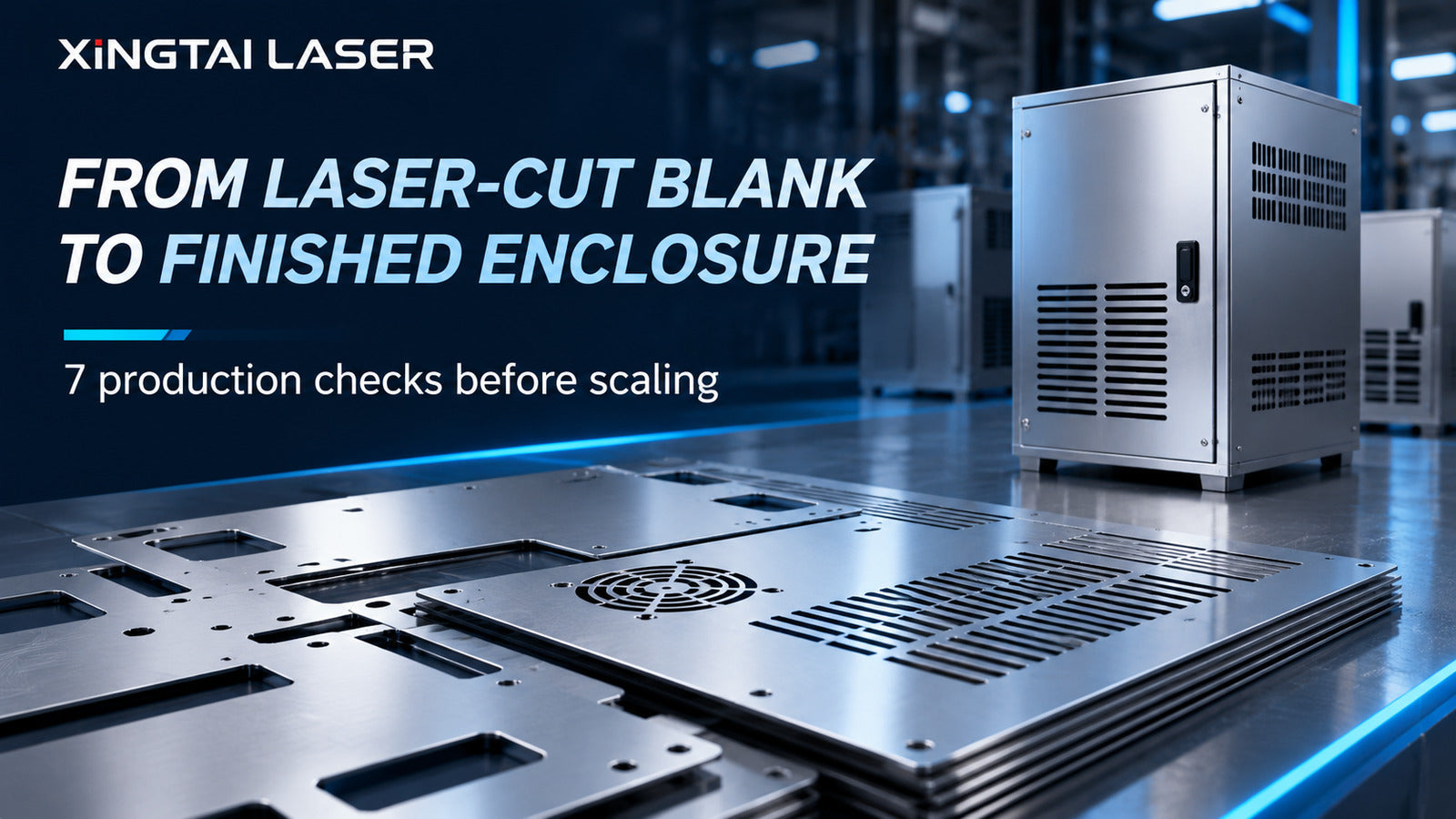
Updated November 1, 2026. A fiber laser cutter can produce a neat sheet-metal blank, but that blank is not yet a usable electrical cabinet or industrial enclosure. Hole positions, bend allowances, edge quality, ventilation layouts, finishing and assembly all influence whether the final product fits and functions as intended.
This distinction was visible in recent manufacturing news. In its October 30, 2026 post-show report, FABTECH's organizer said the Las Vegas event drew more than 32,500 participants and featured 628 product debuts. In a separate October 29 company report, Hymson Laser Machinery said it demonstrated an automated sheet-metal fabrication solution aimed at AI compute cabinets. Those are organizer-reported event figures and a manufacturer's description of its own exhibit, respectively—not independent proof that a particular production line will meet every buyer's requirements.
Our industry takeaway: enclosure manufacturing should be evaluated as a complete process, from design file to inspected assembly. That is relevant to small workshops as well as large automated plants. Here are seven checks to make before increasing production.
1. Start With the Finished Enclosure, Not Just the Cutting File
A flat DXF drawing may show every slot and mounting hole, but it does not tell the whole assembly story. Begin with the enclosure's intended use, overall dimensions, mounting method, internal components, door clearance, service access and required protection level. The product designer should specify the applicable electrical, thermal and safety requirements.
Then connect the 3D design to the flat patterns. Confirm bend direction, bend radius, material thickness, bend allowance and the position of features close to bend lines. A part that looks correct while flat can still create interference after forming.
The most reliable enclosure project starts with a complete drawing package, not a cutting file alone.

2. Match the Material and Thickness to the Real Job
Carbon steel, stainless steel and aluminum are common enclosure materials, but they behave differently during cutting, forming, welding and finishing. Surface condition and protective film may also affect handling and appearance. Specify the material grade, nominal thickness and surface finish before requesting a cutting test.
Do not choose a laser solely by its advertised maximum power. Actual suitability depends on the workpiece size, material, thickness, required edge quality and tested cutting parameters. For coated or corrosion-resistant designs, discuss how later processing and finishing will affect the final surface.
3. Plan Ventilation, Openings and Fasteners Early
Enclosure drawings often contain dense groups of ventilation slots, cable-entry openings, fan patterns, connector cutouts and mounting holes. Their dimensions matter, but so do their locations relative to bends, hardware, reinforcement and internal equipment.
Do not treat a visually attractive vent pattern as proof of adequate cooling. Airflow, electrical clearances, ingress protection and other functional requirements must be evaluated by the responsible product engineers. A laser can cut a pattern; it cannot certify that the enclosure design is safe or compliant.
4. Approve a Real Cut Sample Before Scaling
Test the actual material and representative geometry. Inspect small holes, long slots, narrow bridges, corners and edges—not just one straight cut. Look for dross, burrs, heat discoloration, distortion and inconsistent features. Check whether the cut parts fit the intended fixtures and downstream processes.
For repeat work, agree on an inspection method and acceptable criteria before production. A beautiful photograph is useful, but a measured sample and a successful fit test are more convincing.
A good cut sample should be inspected for edge quality, hole geometry, and repeatability before a larger batch is approved.

5. Design for Bending, Welding and Finishing
Laser cutting is only one operation. A typical enclosure may also require deburring, bending, joining, hardware installation, surface treatment and final assembly. Each step can change the fit or appearance of the part.
For example, hole locations may shift relative to an assembled edge after bending, and a coating can affect close-fitting joints or grounding contact points. Plan the sequence with the fabricator rather than leaving these questions until the parts arrive at assembly.
When evaluating a supplier, ask which steps are included in the quotation and which require separate equipment or subcontracting. A laser cutting machine should not be presented as if it automatically performs all downstream operations.
6. Measure the Whole Workflow, Not Only Cutting Speed
A faster cut does not always mean a faster finished enclosure. Material loading, programming, nesting, part sorting, deburring, bending, welding, coating, inspection and rework can determine the actual delivery time.
For a small factory, a practical production review might track accepted enclosures per shift, setup time per batch, material utilization, scrap, assembly rework and total lead time. These are measurements to collect in the customer's own process, not guaranteed savings from any specific machine.
Automation may be useful where repeated handling or scheduling is a bottleneck, but its return depends on product mix, labor, floor space, maintenance and order volume. A complete automated line is not automatically the right first investment for a small workshop.
7. Inspect the Finished Assembly Against Its Intended Use
Before accepting a production batch, check assembled dimensions, door and panel fit, mounting-hole alignment, fastener engagement, visible finish, edge safety and access for installation or maintenance. Where relevant, verify the enclosure against the project-specific functional and regulatory requirements defined by qualified personnel.
The finished enclosure—not the individual blank—is the unit that should pass final inspection.

What This Means for Small Laser-Cutting Workshops
The recent FABTECH coverage highlights a direction of travel toward connected workflows and application-specific automation. That does not mean every buyer needs a large production line. For prototypes, small brackets, covers and short-run metal parts, a compact cutting setup can be a practical starting point when the parts fit its working area and the application is validated.
Tjxtmachine's XT-4040 desktop fiber laser cutting machine is offered in 800W and 1200W configurations for small-part cutting applications. It should not be described as a full-size cabinet fabrication line. Whether it suits a particular enclosure component depends on dimensions, material, thickness and the results of an actual sample test.
For larger panels or higher-volume production, buyers should evaluate a suitably sized cutting system together with the bending, joining, finishing and quality-control processes required to deliver the finished product.
Questions Buyers Often Ask
Can one fiber laser cutter produce a complete electrical enclosure?
It can cut suitable sheet-metal blanks and features, but a finished enclosure may also need bending, joining, coating, hardware and inspection. The full process must be planned separately.
Is more laser power always better for enclosure parts?
No. Working area, material and thickness, edge quality, accuracy requirements, production volume and operating costs all matter. Ask for a representative sample test rather than comparing power alone.
What should I send before requesting a machine recommendation?
Send part drawings, material and thickness, overall part dimensions, the smallest holes or slots, expected quantity, surface-finish requirements and photos or drawings of the finished assembly. If available, include the planned downstream process and inspection criteria.
Tjxtmachine Perspective
For enclosure manufacturing, the best starting point is a clear product drawing and a realistic sample test. Choose a cutting configuration that matches the actual parts, then confirm how those parts will be formed, finished and assembled. A complete production plan is more useful than an impressive cutting-speed claim without context.
Start with the finished product. Validate the cut. Build the workflow around the job.
Sources and attribution: FABTECH organizer post-show report, October 30, 2026 (organizer-reported event figures); Hymson Laser Machinery, October 29, 2026 (manufacturer description of its FABTECH exhibit); FABTECH Lasers in Manufacturing Workshop, October 22, 2026 (event program). The seven checks and small-workshop recommendations are Tjxtmachine editorial analysis, not independently measured results of the referenced exhibitors. All accompanying illustrations are conceptual and are not photographs or performance tests of a particular Tjxtmachine machine.