AI Welding in 2026: 7 Quality-Control Lessons for Small Fabricators Considering Laser Welding
XINGTAI LASER | Industry Insights | November 1, 2026
Introduction: Welding Automation Is Becoming More Intelligent
For many small fabrication shops, welding quality still depends heavily on the experience of individual operators.
A skilled welder can recognize a poor joint, adjust working technique and identify problems before they become serious defects. However, maintaining the same level of consistency across different operators, shifts and production batches is not always easy.
Recent developments in industrial automation suggest that manufacturers are paying greater attention to this challenge.
On October 28, 2026, Toyota's GAZOO Racing division and Yaskawa Electric announced the practical deployment of an AI-driven robotic welding system at a GR Kart manufacturing facility in Japan.
According to the companies, the system uses sensing and process information to evaluate joint conditions, perform welding, inspect results and make corrections when necessary.
The technology is based on an arc-welding process rather than laser welding.
Nevertheless, the announcement highlights an important manufacturing principle: producing a successful weld is only one part of building a reliable welding process.
For small manufacturers considering handheld laser welding equipment, this distinction matters.
A new machine may help improve production efficiency, but consistent results still depend on material preparation, joint design, operator training, process control and inspection.
This article examines seven practical lessons that small fabrication businesses can apply before investing in laser welding equipment.
1. Joint Fit-Up Matters More Than Many Buyers Expect
One of the most important factors in welding quality is the condition of the joint before welding begins.
Even when two workpieces appear correctly positioned, small variations in gap size, alignment or clamping can influence the welding result.
Poor fit-up may lead to inconsistent penetration, uneven weld appearance, distortion or additional rework.
The acceptable gap depends on the material, thickness, joint configuration and selected welding process.
This is particularly important when evaluating laser welding, where the relationship between beam position and joint geometry can be critical.
Before selecting laser power, confirm that the joint gap, alignment and clamping can be held consistently.

For repetitive production, a suitable fixture can be just as important as the welding machine itself.
2. Material Preparation Should Be Part of the Welding Procedure
Surface condition can affect welding performance.
Oil, rust, moisture, coatings and other contaminants may contribute to inconsistent results or welding defects.
However, the appropriate preparation method depends on the material and the welding requirements.
For example, stainless steel components may require different preparation and handling procedures from carbon steel or aluminum.
Manufacturers should establish a consistent preparation process rather than relying on individual operators to make decisions for every part.
Laser cleaning can be evaluated for certain surface-preparation applications, but it should not automatically be assumed to be suitable for every coating, material or production requirement.
Where cleaning and welding are performed using the same multifunction laser platform, the operator must still verify that each process is appropriate for the workpiece.
3. Understand the Difference Between Arc Welding and Laser Welding
The recent Toyota–Yaskawa announcement concerns an AI-assisted arc-welding system.
It should not be confused with handheld laser welding equipment.
Although both processes join materials, their energy delivery, equipment requirements, joint tolerances and operating conditions can differ substantially.
Handheld laser welding may offer advantages for certain thin-metal assemblies and repetitive fabrication tasks.
However, those potential advantages must be confirmed through application testing.
Laser welding is not automatically the best choice for every material, thickness or joint.
For example, a manufacturer producing thick structural components may have very different requirements from a workshop producing stainless steel cabinets, metal furniture or decorative components.
The correct question is not simply whether laser welding is faster.
It is whether the selected process can consistently produce the required joint quality at an acceptable total production cost.
4. Test Real Production Parts Before Purchasing Equipment
Equipment demonstrations often use carefully prepared sample materials.
These demonstrations can be useful, but they may not represent the conditions of a customer's actual production environment.
A manufacturer should request sample testing using its own material, thickness and joint configuration.
A useful sample test must reproduce the customer's actual material, joint geometry and acceptance criteria.

During evaluation, the customer should consider weld appearance, penetration requirements, distortion, repeatability and any applicable inspection or mechanical-testing requirements.
For production involving multiple operators, the test should also consider whether the process can be reproduced consistently after appropriate training.
One attractive sample does not prove that a machine will deliver the same result throughout an entire production shift.
5. Weld Appearance Is Not the Same as Weld Quality
A smooth, visually attractive weld can be encouraging.
However, external appearance alone cannot establish whether a joint meets its required mechanical or structural performance.
Depending on the application, additional inspection may be necessary.
This may include dimensional checks, visual examination, suitable nondestructive testing or destructive qualification tests.
The inspection method should be selected according to the intended use of the welded component and applicable specifications.
For noncritical decorative products, appearance and dimensional consistency may be major acceptance criteria.
For load-bearing, pressure-containing or safety-critical assemblies, additional engineering requirements may apply.
Manufacturers should define acceptance criteria before production rather than deciding whether a weld is acceptable only after it has been completed.
6. Record the Process, Not Just the Finished Product
One of the most valuable ideas behind intelligent manufacturing is the use of production information to understand process performance.
Small workshops do not necessarily need an expensive AI platform to benefit from better production records.
A basic welding record can include the material, thickness, joint type, equipment configuration, approved process settings, operator, batch identification and inspection results.
When a defect occurs, these records can help the manufacturer investigate possible causes.
A repeatable welding process needs records that explain why a result passed, failed or changed.

For companies producing multiple product variants, maintaining approved procedures for different materials and joints can also reduce unnecessary trial and error.
Digital systems may simplify this work, but a well-managed manual record is still better than having no traceability at all.
7. Safety and Operator Training Must Be Included in Equipment Selection
Welding productivity should never be evaluated separately from workplace safety.
Handheld laser welding systems introduce hazards that require appropriate engineering controls, protective measures, training and operating procedures.
These include direct and reflected laser radiation, welding fumes, hot materials and other process-related risks.
In August 2026, the second edition of ISO 11553-2 was published, addressing safety requirements for hand-held and hand-operated laser processing machines.
The standard provides a relevant reference for evaluating equipment safety, although applicable legal and technical requirements vary by market and application.
Before purchasing equipment, buyers should confirm the machine's safety documentation, required protective measures, training arrangements and local regulatory obligations.
A machine that appears easy to operate still requires proper risk assessment and authorized personnel.
What Should a Small Fabrication Shop Do First?
The latest developments in AI-assisted welding demonstrate how advanced manufacturers are trying to make welding processes more adaptive and consistent.
But small workshops do not need to reproduce an advanced robotic production system immediately.
A practical improvement plan can begin with four questions.
First, which products currently create the most welding rework or production delays?
Second, are the problems caused by equipment limitations, poor fit-up, inconsistent preparation or operator variation?
Third, can a different welding process improve the result without creating unacceptable safety or operating costs?
Fourth, what evidence will demonstrate that the new process is better?
A pilot project should compare the existing method with the proposed equipment using representative production parts.
Relevant measurements may include accepted parts per shift, rework, material consumption, preparation time, inspection results and total operating cost.
The objective is not to obtain the highest possible welding speed during a demonstration.
It is to establish a process that can be repeated reliably in everyday production.
Where Does Handheld Laser Welding Fit?
Handheld laser welding can be worth evaluating for manufacturers working with suitable metal components, particularly when production involves repetitive joints and a need for flexible operation.
Potential applications include selected stainless steel products, sheet-metal assemblies, metal furniture components and customized fabrication work.
However, suitability depends on the actual material, joint geometry, thickness, required quality and operating environment.
XINGTAI LASER offers handheld multifunction laser equipment with welding, cleaning, weld-seam cleaning and cutting functions.
These functions should be evaluated individually against the customer's requirements.
This equipment should not be confused with the AI-driven robotic welding technology described in the Toyota–Yaskawa announcement.
The company does not claim that its standard handheld welding equipment automatically recognizes joint conditions, independently corrects weld defects or provides autonomous AI inspection.
For customers considering a new welding system, the most useful starting point is a representative sample test and a clear discussion of the production requirements.
Frequently Asked Questions
Is AI robotic welding the same as laser welding?
No. AI refers to sensing, decision-making or control capabilities, while laser welding describes a specific material-joining process.
An AI-controlled welding system may use arc welding, laser welding or another process depending on its design.
Can handheld laser welding replace traditional welding?
It can be an alternative for certain applications, but it is not a universal replacement.
Material properties, joint design, thickness, quality requirements, safety and production economics must be evaluated.
What should buyers send when requesting a welding sample?
Useful information includes material grade, thickness, joint drawings, photographs, expected production volume and acceptance requirements.
If mechanical performance is important, the required inspection or qualification method should also be specified.
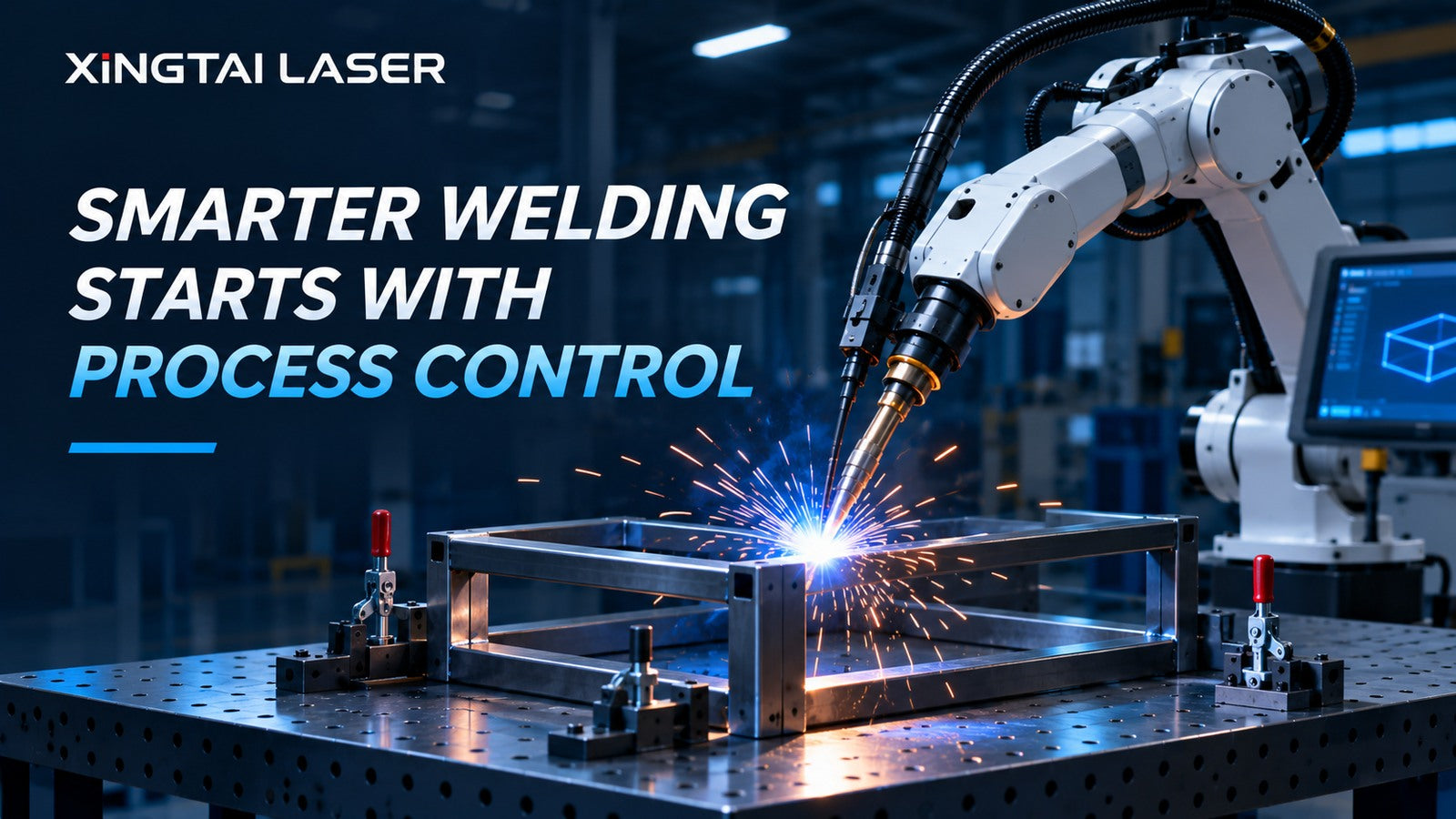
Conclusion: Better Welding Starts With Better Process Decisions
The October 2026 Toyota–Yaskawa announcement offers an interesting example of how industrial automation is moving toward more adaptive production.
Its broader lesson is relevant well beyond robotic arc welding.
Reliable manufacturing depends on understanding the workpiece, controlling the process and verifying the result.
For small fabrication businesses considering laser welding, the priority should be practical.
Start with real production parts, evaluate the joint and material requirements, confirm safety arrangements and measure repeatable quality.
The best welding investment is not necessarily the most automated machine. It is the solution that consistently meets the customer's production requirements.
Sources and Further Reading
Industry news: Toyota GAZOO Racing and Yaskawa Electric joint announcement, October 28, 2026. Safety reference: ISO 11553-2:2026. The robotic arc-welding example is not a claim about XINGTAI LASER product capabilities.