One Machine, More Possibilities: Why Flexibility Is Becoming More Important in Laser Manufacturing

XINGTAI LASER Industry Weekly | September 7–13, 2026
For many years, industrial equipment was designed around a simple idea:
One machine. One job.
A cutting machine was used for cutting.
A welding machine was used for welding.
A marking machine was used for marking.
A cleaning system was used for surface preparation.
That approach still makes sense in large factories producing thousands of identical parts every day.
But modern manufacturing is changing.
More companies are dealing with:
Smaller orders.
More product variations.
Faster delivery requirements.
Customized production.
Shorter product life cycles.
For these manufacturers, maximum production speed is not always the most important question.
Another question is becoming increasingly important:
How many different production problems can this equipment help me solve?
That is why flexibility is becoming one of the most important trends in industrial laser technology.

1. The Manufacturing Customer Is Changing
Imagine two factories.
Factory A produces 100,000 identical metal components every month.
Factory B produces:
200 brackets today,
50 customized stainless-steel enclosures tomorrow,
a prototype next week,
and then another completely different customer order.
The two factories should not necessarily buy equipment using the same logic.
Factory A needs maximum productivity.
Factory B needs:
Flexibility.
And there are a lot more “Factory Bs” than many people realize.
Small metal workshops, jewelry manufacturers, advertising companies, automotive modification businesses, hardware manufacturers, repair workshops and product-development companies frequently deal with changing orders.
For these companies, being able to move quickly from one job to another has real financial value.
2. This Is Already Visible in Laser Welding
Handheld laser welding is a good example.
Originally, the main selling point of handheld laser welding was straightforward:
Weld faster and make welding easier.
But the technology has continued to evolve.
Depending on system configuration, some modern handheld laser welding platforms can now combine several processes such as:
Welding
Cutting
Cleaning
Weld seam cleaning
into one platform.
At FABTECH 2026, IPG Photonics is highlighting handheld laser welding systems that integrate pre- and post-weld cleaning functions, with the goal of reducing additional processing and improving the overall welding workflow.
This is an important change.
The value of the machine is no longer only:
“How fast can it weld?”
It can also become:
“How many steps can I remove from the production process?”

3. Why Pre-Weld and Post-Weld Processing Matter
Think about a normal welding job.
The actual weld may only be one part of the work.
Before welding, the operator may need to remove:
rust,
oil,
oxide,
paint,
or other contamination.
After welding, additional surface treatment may be required.
Traditionally, this can involve several tools or processes.
For example:
Grinding → Cleaning → Welding → Grinding → Finishing
Every additional step means:
more labor,
more handling,
more equipment,
and more time.
If laser technology can combine or simplify several of these steps, the productivity improvement does not come only from welding faster.
It comes from simplifying the entire workflow.
This is an important distinction.
4. Laser Cleaning Is Moving Closer to Production
Laser cleaning is another good example.
For a long time, laser cleaning was treated almost like a separate niche technology.
Today it is increasingly being discussed as part of normal manufacturing.
FABTECH's 2026 Lasers in Manufacturing Workshop specifically includes practical laser marking and cleaning automation, covering issues such as material compatibility, inline integration, motion control, machine vision, robotic handling and scalable production workflows.
This tells us something important.
Laser cleaning is not only about:
“Removing rust with a laser.”
It can become part of:
surface preparation, welding preparation, coating removal, maintenance and automated production.
Once a process becomes connected to the production line, the value of automation becomes much greater.
5. Laser Marking Is Also Becoming More Than “Putting a Logo on a Product”
The same transition is happening in laser marking.
A basic laser marking machine can engrave:
logos,
names,
text,
serial numbers,
patterns,
QR codes.
But industrial manufacturers increasingly need something more.
They need:
Traceability.
A component may need a unique identification code.
That code may need to survive:
assembly,
cleaning,
coating,
transportation,
and years of use.
The marking therefore becomes part of the product's manufacturing data.
This is one reason the industrial laser marking market continues to attract investment. Current market research estimates the global laser marking machine market at roughly $3.48 billion in 2026, with further growth projected through 2030.
In other words:
The laser is no longer simply creating a mark.
It is connecting the physical product with digital production information.
6. Vision Makes Flexible Production Even More Powerful
There is another technology that fits naturally into this trend:
Machine Vision.
Traditional laser processing often assumes that the workpiece is placed in exactly the correct position.
But flexible manufacturing does not always work that way.
Products may arrive:
slightly rotated,
in different positions,
with different orientations,
or mixed together.
A vision system can identify the workpiece and help the laser locate the correct processing area.
This can be especially valuable for:
Jewelry
Electronic components
PCB
Medical products
Customized parts
Small-batch manufacturing
Instead of spending time manually aligning every product, the operator can increasingly allow software and cameras to handle part of the positioning process.
This is another example of how laser manufacturing is moving beyond the laser source itself.
7. Compact Machines Are Part of the Same Trend
Flexibility is not only about software.
It is also about machine size.
For decades, industrial laser cutting was associated with large factory equipment.
That remains necessary for large sheets and high-volume production.
But not every manufacturer needs that.
Consider a jewelry manufacturer producing small metal components.
Or an automotive customization workshop making brackets.
Or a university developing prototypes.
Or a hardware company producing small batches of customized parts.
For these users, a huge cutting table may actually create unnecessary cost and consume valuable floor space.
This is where compact fiber laser cutting systems become interesting.
A smaller machine does not try to replace a large industrial cutting line.
It solves a different problem:
How can I bring precision metal cutting into my own workshop without building an entire laser cutting factory?

That is the thinking behind compact machines such as the XT-4040.
8. Higher Power Is Not Always the Answer
Laser manufacturers love talking about power.
And buyers naturally compare numbers.
20W.
100W.
800W.
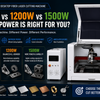
1200W.
1500W.
3000W.
10,000W.
20,000W.
Power matters.
But more power is only valuable when the application actually requires it.
A jewelry workshop cutting small thin components does not have the same requirements as a factory cutting thick structural steel.
A business engraving names on jewelry does not need the same laser configuration as a company performing deep metal engraving.
A repair workshop does not necessarily need a fully automated welding robot.
The better question is:
What does my production actually require?
Then choose the technology around that requirement.
Not the other way around.
9. Flexibility Can Reduce the Risk of Investing in Equipment
This matters especially for small businesses.
Buying industrial equipment is an investment.
And one of the biggest risks is buying a machine that solves only one very narrow problem.
What happens if customer demand changes?
What happens if your main product changes?
What happens if you begin receiving different materials?
What happens if your business moves from standard production into customized products?
This is why buyers should increasingly consider:
Can the machine be upgraded?
Can accessories be added?
Can a rotary axis be added?
Can vision positioning be integrated?
Can the software support future automation?
Can the machine handle different production jobs?
A machine does not need to do everything.
But having room to grow can make the investment much safer.
10. Small-Batch Manufacturing Is Changing the Definition of Productivity
This may be the most important point.
Traditionally, productivity meant:
How many pieces can I produce per hour?
For mass production, that definition still works.
But for customized manufacturing, productivity can mean something different.
It may mean:
How quickly can I change from Product A to Product B?
How quickly can I test a new design?
How easily can I produce 20 pieces instead of 20,000?
How much outsourcing can I eliminate?
How many processes can I complete inside my own workshop?
That is a different definition of manufacturing efficiency.
And laser technology fits extremely well into this new environment because it is fundamentally digital.
Change the design file.
Change the parameters.
Change the material.
Start another job.
That flexibility is difficult to achieve with many traditional manufacturing methods.
What Should Buyers Look for in Their Next Laser Machine?
The answer should not begin with:
“Buy the highest power you can afford.”
Instead, start with your products.
Ask:
What materials do I process?
What thicknesses?
What size are my products?
How many pieces do I produce?
How often do my designs change?
Do I need cutting, welding, marking or cleaning?
Will I need automation later?
Do I need vision positioning?
Do I expect my production to change over the next three years?
These questions usually lead to a much better equipment decision than simply comparing wattage.
From One Machine to One Manufacturing Capability
This week's industry developments reinforce something we believe is becoming increasingly important.
Manufacturers are not really buying machines.
They are buying:
Production capabilities.
A fiber laser marker gives a company the ability to permanently identify and customize products.
A jewelry laser welder gives a workshop the ability to repair delicate jewelry.
A compact fiber laser cutter gives a small manufacturer the ability to produce metal parts internally.
A laser cleaning system gives a factory another way to prepare and maintain surfaces.
And a multifunction laser welding platform may allow one workshop to complete several operations with the same system.
The value is not the machine sitting in the workshop.
The value is:
What new work can the workshop accept because that machine is there?
XINGTAI LASER Weekly Insight
The laser industry will continue to develop higher-power machines.
But at the same time, another race is happening.
Manufacturers are competing to make laser equipment:
More flexible.
More compact.
Easier to operate.
Easier to automate.
Capable of solving more production problems.
For large factories, productivity will always matter.
For small and medium-sized manufacturers, however, flexibility may become equally important.
Because the best machine is not necessarily the machine with the biggest number on the specification sheet.
It is the machine that helps you accept more jobs, solve more problems, and adapt when your business changes.
And that may be one of the most important directions in laser manufacturing today.
XINGTAI LASER | Laser Manufacturing Solutions
Fiber Laser Cutting | Laser Marking | Jewelry Laser Welding | Handheld Laser Welding | Laser Cleaning | Machine Vision
If you are not sure which laser configuration fits your application, start with the product rather than the machine.
Send us the material, thickness, product photo and required processing result. We can evaluate the application first and recommend the appropriate solution.
WhatsApp: +86 18722099531
Email: rachel@tjxtmachine.com
XINGTAI LASER