AI Is Changing Laser Welding: From Trial-and-Error to Predictive Manufacturing
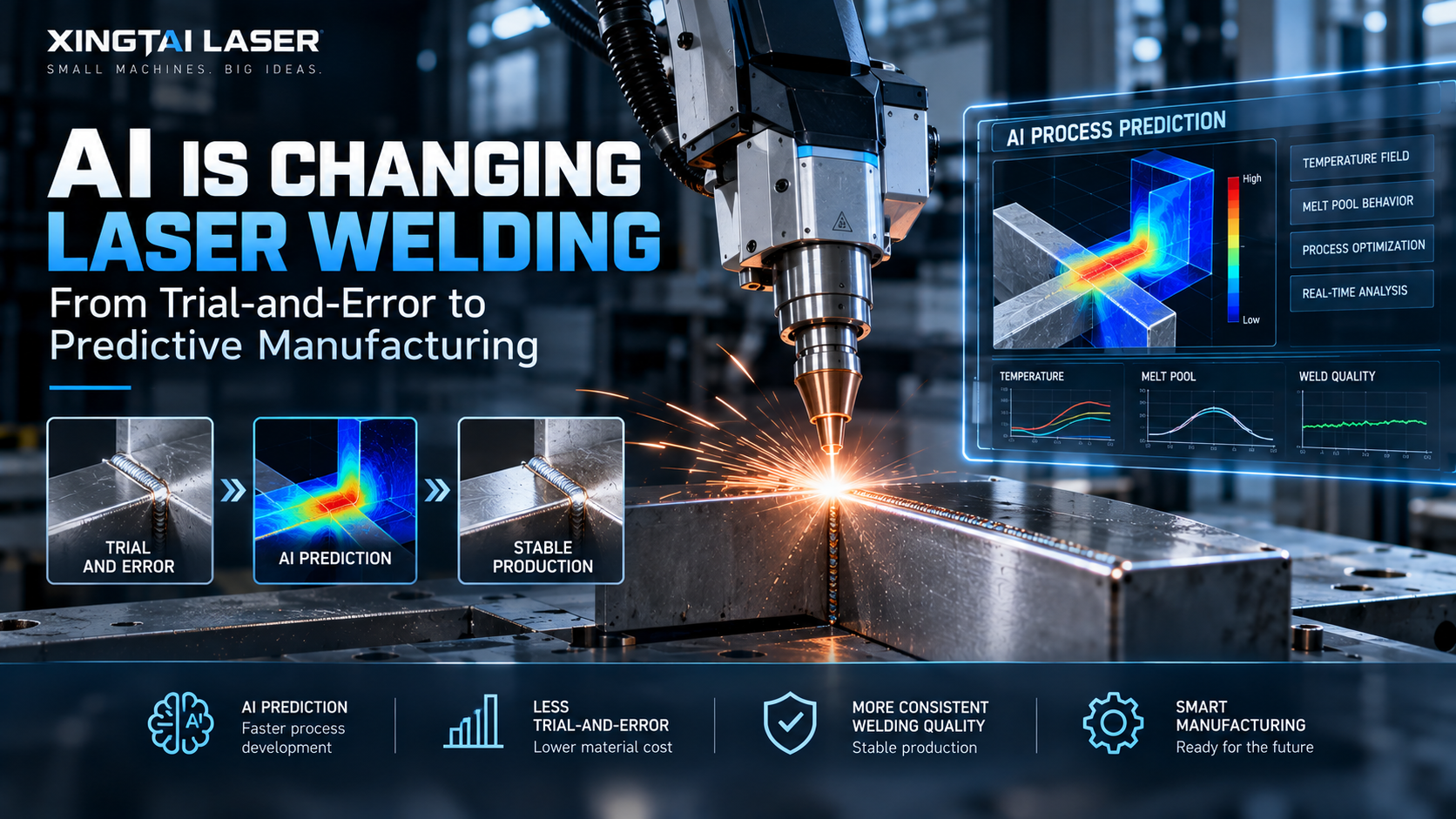
For decades, one of the most familiar ways to set up a laser welding process has been surprisingly simple:
Choose a starting parameter.
Make a weld.
Inspect the result.
Adjust the power or speed.
Try again.
Experienced engineers can make this process highly effective. But it still requires time, material and experience — especially when a new material, thickness, joint or production requirement is introduced.
Now artificial intelligence is beginning to challenge that traditional workflow.
Researchers at Empa and Terra Quantum recently introduced an AI-based model capable of predicting three-dimensional temperature fields and melt-pool behavior in laser processing in milliseconds rather than minutes or hours.
The development does not mean laser welding machines can suddenly “think for themselves.”
But it points toward something potentially much more important:
A future in which manufacturers can predict what may happen during laser processing before producing a bad part.
1. Why Laser Welding Is Difficult to Predict
Laser welding may look simple from the outside.
A focused laser beam moves across a joint and melts the material.
But underneath the surface, several physical processes are happening at the same time.
Heat is moving through the material.
Metal is melting.
Molten metal is flowing.
Material may evaporate.
A keyhole may form.
Laser energy is reflected and absorbed.
And all of these effects can influence the final weld.
This means two parameters that look very simple on a machine screen —
Laser Power
and
Welding Speed
— can create very different melt-pool conditions.
That is why experienced application engineers still matter.
2. Simulation Can Help — But Traditionally It Has Been Slow
Engineers can use physics-based simulation to understand what is happening inside the weld.
The problem is computational cost.
According to Empa, high-fidelity laser-welding simulations may require minutes or even more than an hour depending on resolution.
That is useful for research.
But it is difficult to use a simulation that takes an hour if the actual manufacturing process happens in seconds.
This creates a fundamental problem:
A prediction is much less useful for real-time manufacturing if the calculation arrives after the part has already been produced.
This is where AI becomes interesting.
3. From Hours to Milliseconds
The new model developed by Empa and Terra Quantum is called the:
Laser Processing Fourier Neural Operator — LP-FNO.
Instead of repeatedly calculating the complete physics of the process from the beginning, the AI surrogate model learns the relationship between processing parameters and the resulting temperature field and melt-pool geometry.
In the reported research, the model was trained using high-fidelity simulations of Ti-6Al-4V titanium alloy.
The investigated process window included laser powers between 40 and 190 watts and scanning speeds from 0.1 to 1 meter per second.
Once trained, LP-FNO reportedly produced a full 3D prediction in approximately:
8 milliseconds at standard resolution
and
88 milliseconds at higher resolution.
The researchers report speed improvements of up to 100,000 times compared with conventional high-fidelity multiphysics simulation.
That difference changes the discussion completely.
4. What Could This Mean on a Factory Floor?
Imagine a manufacturer preparing to weld a new titanium component.
Traditionally, the application engineer may begin with experience and recommended parameters.
Then comes testing.
Weld.
Inspect.
Adjust.
Weld again.
Inspect again.
Now imagine software that can quickly estimate how a parameter change may affect the melt pool before the next physical test.
Instead of:
Parameter → Weld → Inspect → Adjust
the workflow could increasingly become:
Parameter → Predict → Optimize → Weld → Verify
This does not eliminate physical testing.
But it could eventually reduce how much trial-and-error is required.
5. Less Trial-and-Error Could Mean Less Waste
This is where advanced AI research becomes relevant even to manufacturers that do not operate research laboratories.
Every unsuccessful test consumes something:
material,
operator time,
machine time,
shielding gas,
electricity,
and production capacity.
For expensive materials, the cost becomes even more important.
Consider industries working with:
Titanium
Nickel alloys
Medical components
Aerospace parts
Precision electronics
Reducing unnecessary physical experiments can have real economic value.
The goal is not simply “AI for AI's sake.”
The goal is:
Reach a stable production window faster.

6. Digital Twins Become More Interesting
Another important possibility is the industrial digital twin.
A digital twin is not simply a 3D model of a machine.
In manufacturing, the more useful idea is a digital representation that reflects what is happening in the physical process.
For laser welding, that could eventually combine information such as:
laser power,
welding speed,
temperature,
melt-pool behavior,
machine data,
sensor information,
and weld quality.
Traditional simulation has made this difficult because detailed calculations can be too slow.
If AI models can produce sufficiently accurate predictions in milliseconds, a digital model could operate much closer to the speed of the real manufacturing process.
That opens the door to much more useful process monitoring and optimization.
7. The Bigger Goal: Closed-Loop Laser Processing
Prediction is only one step.
The bigger goal is closed-loop control.
Today, many laser processes operate largely according to predefined parameters.
The machine is instructed:
Use this power.
Move at this speed.
Follow this path.
A future closed-loop system could operate differently.
Step 1 — Sensors observe the process.
Step 2 — Software interprets what is happening.
Step 3 — AI predicts whether the process is moving outside the desired window.
Step 4 — The machine adjusts a parameter.
Step 5 — Sensors verify the result.
That creates a loop:
Sense → Predict → Adjust → Verify
This is much closer to a machine that understands the manufacturing process rather than simply following coordinates.
But this remains a development direction, not a universal capability of today's laser welding machines. Empa itself notes that highly transient phenomena such as pore formation and keyhole collapse still present challenges.
8. The Same Trend Is Appearing in Laser Cutting
This week's industry developments show a similar direction outside welding.
Recent work in precision laser cutting is exploring real-time monitoring of process signals while the laser is cutting, rather than relying only on inspection after the part is finished.
The long-term question is important:
Can the machine recognize that cutting quality is deteriorating before it produces a defective part?
That would represent a major change.
Traditional manufacturing often follows:
Process → Inspect → Find Defect
Smart manufacturing aims for:
Process → Monitor → Predict → Correct
This is the difference between detecting a problem and preventing one.
9. Machine Vision Is Becoming Part of the Same System
AI cannot improve manufacturing without useful information.
That is why machine vision, sensors and process monitoring are becoming increasingly important.
A September 28 review of IMTS 2026 noted that machine vision increasingly appeared inside broader inspection, measurement and robotic systems rather than as a standalone technology.
This is an important shift.
Factories do not necessarily need “a camera.”
They need the machine to understand:
Where is the part?
Is the feature correct?
Is the weld acceptable?
Is the mark readable?
Has the process changed?
That means the future production system increasingly looks like:
Laser + Sensors + Vision + AI + Software + Automation
rather than simply:
Laser + CNC.
10. Does This Mean Skilled Operators Will Disappear?
No.
In fact, the opposite may happen.
As laser systems become smarter, operators may spend less time manually searching for parameters and more time understanding:
materials,
joint design,
process limits,
quality requirements,
automation,
and production optimization.
AI can calculate quickly.
But somebody still needs to define what a good weld actually means.
For one product, appearance may be most important.
For another, penetration depth matters.
For another, deformation must be minimized.
And for safety-critical components, mechanical performance and qualification may matter far more than appearance.
Manufacturing knowledge does not disappear.
It becomes more valuable at a higher level.
11. What Does This Mean for Small and Medium-Sized Manufacturers?
Most small factories will not install an advanced AI welding digital twin tomorrow.
That is not the important point.
The important point is the direction of technology.
Features that begin in research laboratories often gradually move into industrial equipment as:
automatic parameter recommendations,
process monitoring,
vision-assisted positioning,
quality detection,
automatic focus,
intelligent alarms,
production data collection,
and eventually adaptive process control.
We have already seen a similar transition in many manufacturing technologies.
What begins as advanced automation eventually becomes an expected machine feature.
XINGTAI LASER Weekly Insight
For many years, laser-machine development was easy to describe:
More Power.
Then manufacturers began asking for:
More Speed.
Today, another requirement is becoming increasingly important:
More Intelligence.
The future laser machine will not only need to produce energy accurately.
It will increasingly need to understand what is happening during production.
The development of AI models such as LP-FNO is still an early step, and the current research has a defined material and parameter range.
But reducing complex laser-process prediction from minutes or hours to milliseconds is significant.
Because once prediction becomes fast enough, a new possibility appears:
Instead of discovering a bad process after making the part, the machine may eventually help prevent the bad part from being made.
For manufacturers, that could mean something much more valuable than another increase in laser power:
Less trial-and-error.
Less scrap.
Faster process development.
More consistent production.
And ultimately:
A smarter way to manufacture.