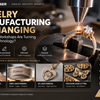
Jewelry Manufacturing Is Changing: Why More Workshops Are Turning to Laser Technology
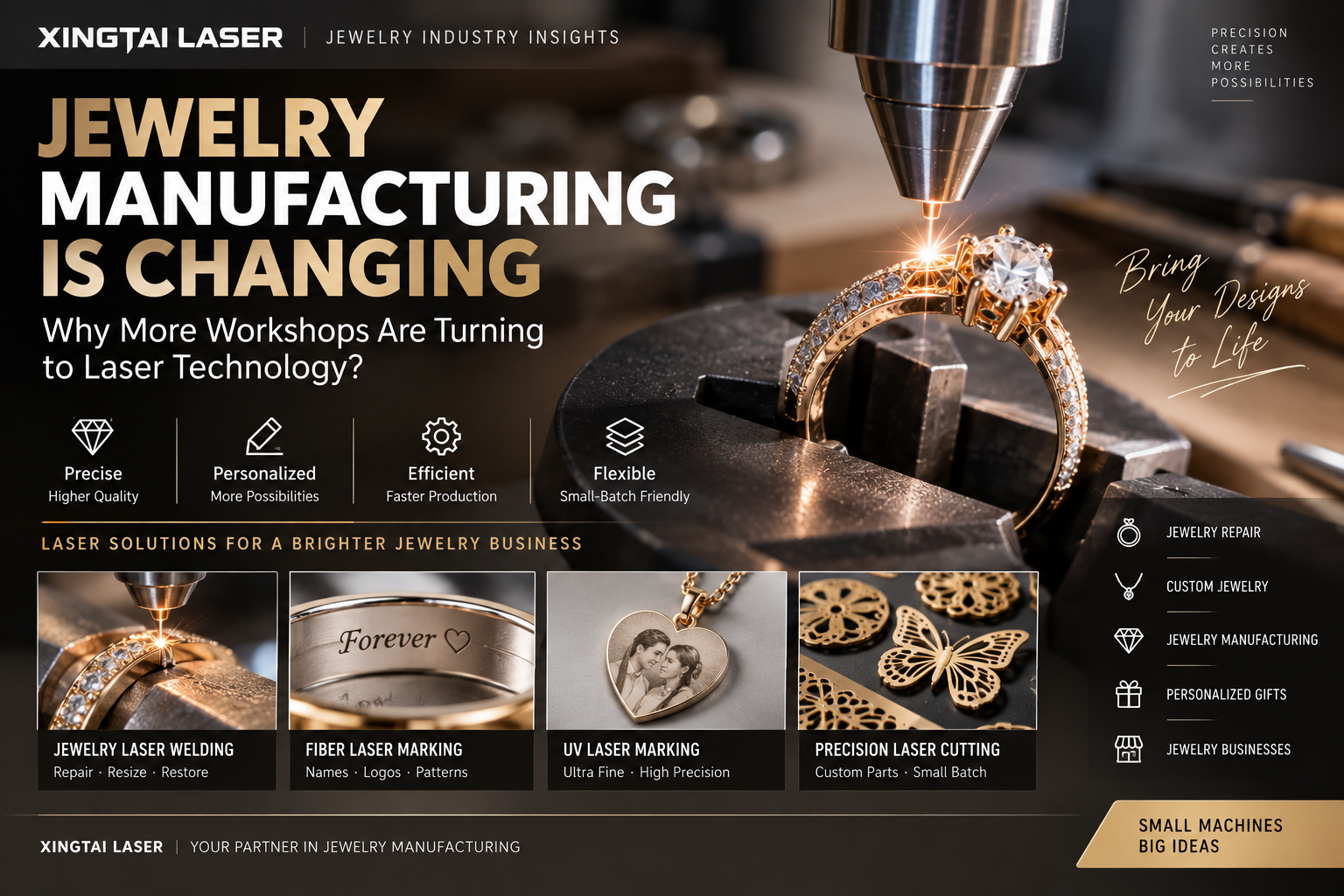
XINGTAI LASER | Jewelry Industry Insights 2026
Walk into a traditional jewelry workshop and you will probably see many familiar tools.
A workbench.
A torch.
Polishing equipment.
Hand tools.
A microscope.
And, of course, an experienced jeweler.
These tools are not disappearing.
But something else is increasingly appearing beside them:
Laser technology.
Laser welding, laser marking, engraving, and precision cutting are gradually changing how jewelry is repaired, customized, identified, and manufactured.
And the reason is not simply that lasers are “newer.”
The jewelry business itself is changing.
Customers want more personalization.
Workshops are handling smaller production batches.
Designs are becoming more detailed.
Precious metals are expensive.
And customers expect repairs to be completed quickly without unnecessary damage to the original piece.
For many jewelry businesses, precision and flexibility are becoming just as important as craftsmanship.

1. Jewelry Repair Is Becoming More Precise
Jewelry repair is one of the clearest examples.
Imagine repairing a delicate gold ring with a small crack near a gemstone.
With traditional heat-based techniques, controlling the heat-affected area can be challenging.
This becomes especially important when working around:
- Gemstones
- Thin chains
- Small clasps
- Fine settings
- Antique jewelry
- Detailed decorative structures
A jewelry laser welding machine concentrates energy into a very small area.
Instead of heating a large section of the jewelry, the operator can work much more precisely around the repair point.
This makes laser welding particularly useful for jobs such as:
Ring resizing, chain repair, prong repair, filling porosity, repairing small cracks, attaching components, and restoring damaged jewelry.
For a jewelry repair business, this is not simply about welding faster.
It is about having more control over delicate and valuable pieces.
2. Personalization Is Becoming a Bigger Part of the Jewelry Business
Jewelry customers increasingly want something that feels personal.
A name.
A date.
A fingerprint.
A short message.
A logo.
A photograph.
A serial number.
Even a tiny QR code.
This is one reason laser marking and engraving have become so useful in jewelry production.
A fiber laser can create precise permanent markings on many metal jewelry products.
That allows workshops to offer personalization without relying entirely on traditional mechanical engraving.
For example:
A customer buys a bracelet.
Instead of selling only the bracelet, the jeweler can offer:
“Would you like us to engrave a name or date?”
That small service can turn a standard product into a personalized product.
And personalized products often create something every jewelry business wants:
Higher added value.
3. Small-Batch Production Is Becoming More Important
Not every jewelry manufacturer produces thousands of identical pieces.
Many modern jewelry businesses work differently.
They may produce:
20 pieces of one design.
Then 50 pieces of another.
Then a customized order for a specific customer.
Then a completely new collection.
This type of production requires flexibility.
That is where digital manufacturing becomes particularly useful.
Once a design is prepared digitally, laser equipment can help manufacturers repeat the same pattern or marking consistently.
If the design changes?
Change the file.
If the customer wants a different name?
Change the text.
If the next batch requires another logo?
Load another design.
For smaller jewelry manufacturers, this ability to move quickly between products can be more valuable than traditional mass-production speed.
4. Precious Metal Waste Matters
When working with stainless steel, a small amount of material waste may not seem important.
When working with:
Gold, silver, platinum, or other valuable materials,
the calculation changes.
Every gram matters.
Jewelry manufacturers therefore care deeply about:
Precision, kerf, material utilization, rework, and scrap.
This is one reason precision laser processing is attractive for jewelry applications.
The objective is not simply:
“Can the machine cut metal?”
The more important question is:
“Can I manufacture the part accurately while minimizing unnecessary material loss?”
For jewelry production, precision has a direct financial value.
5. One Jewelry Workshop May Need More Than One Type of Laser
Another interesting change is that jewelry businesses are beginning to use different laser technologies for different jobs.
There is no single “jewelry laser” that is best at everything.
Jewelry Laser Welding
Best suited to jobs such as:
repairing rings and chains,
repairing prongs,
filling small defects,
joining delicate components,
and precision welding around complex jewelry structures.
Fiber Laser Marking
Useful for:
names,
logos,
serial numbers,
patterns,
text,
identification,
and permanent metal engraving.
Higher-power and suitable MOPA configurations can also expand the possibilities for deeper engraving and specialized marking applications.
UV Laser Marking
Useful when the application requires very fine processing or involves materials where a smaller heat-affected area is desirable.
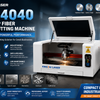
Compact Fiber Laser Cutting
For jewelry manufacturers producing small metal components, compact cutting equipment can provide another option for prototypes and small-batch manufacturing.
Different machines solve different problems.
The important thing is understanding the actual production process before choosing the technology.
6. Jewelry Manufacturing Is Becoming More Digital
Perhaps the biggest change is not actually the laser.
It is the workflow around it.
Traditional jewelry manufacturing depends heavily on individual craftsmanship.
That craftsmanship will remain extremely important.
But more workshops are combining craftsmanship with:
CAD design + digital files + laser processing + precision positioning + software-controlled production.
This creates an interesting combination.
The jeweler still makes the creative decisions.
The machine helps repeat those decisions accurately.
In other words:
Technology does not have to replace craftsmanship. It can give craftsmanship more precision.
That distinction is particularly important in jewelry.
Customers are not buying industrial components.
They are often buying something emotional:
a wedding ring,
an anniversary gift,
a family heirloom,
a personalized necklace,
or a piece created for one specific person.
The technology should support that value—not remove it.
7. The Jewelry Repair Shop May Become a Small Digital Factory
This may be one of the most interesting developments for smaller jewelry businesses.
A traditional jewelry repair shop primarily earns money from:
repair,
polishing,
resizing,
and maintenance.
But once digital equipment is introduced, the same workshop can potentially offer more services.
For example:
Repair → Laser Welding
Personalization → Laser Engraving
Branding → Logo Marking
Custom Orders → Digital Design
Small-Batch Production → Precision Laser Processing
The workshop is no longer only repairing jewelry.
It begins to become a small flexible manufacturing center.
That can create new revenue without requiring the business to become a large jewelry factory.
8. Buying the Right Machine Starts With the Jewelry — Not the Wattage
We receive many questions that begin like this:
“How many watts should I buy?”
But for jewelry applications, that is usually not the best first question.
A better conversation starts with:
What exactly are you making?
Are you repairing gold rings?
Engraving stainless steel jewelry?
Cutting thin silver pieces?
Marking inside rings?
Producing customized pendants?
Working with gold, silver, platinum, stainless steel, brass, or another material?
The answers determine the appropriate laser technology.
For example, a jewelry repair shop and a jewelry manufacturer may both work with gold.
But their equipment requirements can be completely different.
That is why we prefer customers to send us:
- Material
- Product photos
- Dimensions
- Thickness
- Required process
- Example of the desired result
Whenever possible, testing a real sample is even better.
Because in jewelry manufacturing:
A beautiful sample tells you much more than a specification sheet.
The Future of Jewelry Manufacturing Is Precision + Personalization
Jewelry will always be an industry built around design, craftsmanship, and emotion.
Technology will not change that.
But technology is changing how those ideas become finished products.
Laser welding allows more precise repairs.
Laser marking makes personalization easier.
Digital production makes small batches more practical.
Precision processing helps manufacturers work more carefully with valuable materials.
And software allows workshops to move from one customized product to another much faster.
For large jewelry manufacturers, these technologies can improve production efficiency.
For small jewelry workshops, they can create entirely new services.
That is why the role of laser technology in jewelry is likely to continue growing.
Not because jewelry needs to become more industrial.
But because jewelry customers increasingly expect something that is:
Precise. Personal. Fast. And uniquely theirs.
XINGTAI LASER | Jewelry Manufacturing Solutions
We work with jewelry manufacturers, repair workshops, custom jewelry studios, and jewelry businesses in different markets to help evaluate suitable laser processing solutions.
Our jewelry-related applications include:
Jewelry Laser Welding | Fiber Laser Marking | UV Laser Marking | Precision Metal Cutting
If you are unsure which laser technology fits your jewelry business, send us a photo of the product and tell us what you want to do with it.
We can evaluate the application before recommending a machine.
WhatsApp: +86 18722099531
Email: rachel@tjxtmachine.com
XINGTAI LASER