Can a Small Fiber Laser Cutter Really Replace Outsourcing?
For Small-Batch Metal Parts, the Answer May Be Different Than You Think
A customer needs 20 custom stainless steel brackets.
The drawing is already finished.
The parts are not complicated.
The actual cutting time may only be a few minutes.
But because the company does not have its own metal cutting equipment, the process looks something like this:
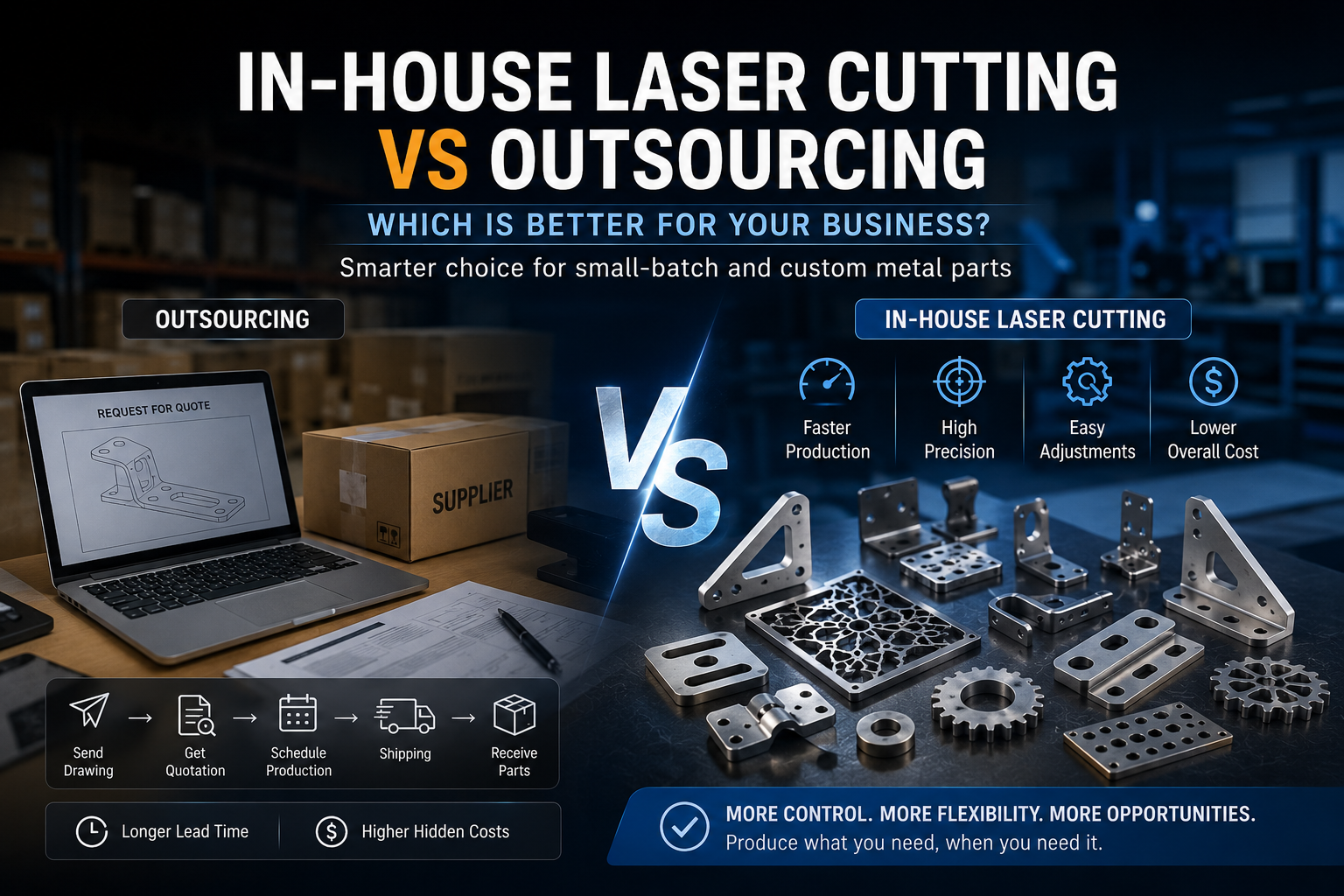
Send drawing → Request quotation → Confirm price → Wait for production → Arrange shipping → Receive parts → Check samples
If the first version is not quite right?
Change the drawing and start again.
This is something we hear quite often from small manufacturers.
The problem is not always the cost of the parts themselves.
Sometimes the bigger cost is simply waiting.
That is why more small workshops are beginning to ask a different question:
Does it still make sense to outsource every small metal cutting job?
With compact fiber laser cutting machines becoming smaller and more accessible, in-house production is no longer something only large factories can consider.
But does buying your own small fiber laser cutter really make financial sense?
Let's look at it realistically.
Why Do Small Businesses Outsource Metal Cutting in the First Place?
There is nothing wrong with outsourcing.
In fact, for many businesses, it is still the smartest option.
If you only need metal parts a few times per year, purchasing a machine probably makes no sense.
You send the drawing to a supplier, pay for the parts, and move on.
Simple.
The problem begins when those “occasional” jobs stop being occasional.
Maybe you are developing new products every month.
Maybe customers frequently ask for customized brackets or components.
Maybe you need prototypes before confirming a larger order.
Or perhaps you constantly need only 10, 20, or 50 pieces at a time.
At that point, outsourcing starts creating a different kind of cost.
Not just money.
But time, flexibility, and control.
The Hidden Cost of Outsourcing Small-Batch Metal Parts
Suppose you need a simple stainless steel component.
The supplier may quote a perfectly reasonable cutting price.
But that is rarely the whole story.
There may also be:
- Minimum order quantities;
- Setup charges;
- Shipping costs;
- Communication time;
- Drawing confirmation;
- Production lead time;
- Sample approval;
- Rework if dimensions change.
For a large production order, these costs can be spread across thousands of parts.
For a small order?
They become much more noticeable.
This is especially true for companies that regularly make prototypes or customized products.
Sometimes you are not waiting for production.
You are waiting for your small job to fit into someone else's production schedule.
And that can be frustrating.
The Bigger Problem: Product Development Slows Down
This is where in-house laser cutting becomes interesting.
Imagine your engineering team designs a new bracket on Monday morning.
With outsourcing, you may need to send the drawing, wait for a quotation, confirm the order, and then wait for the part to arrive.
When the sample finally comes back, you discover one mounting hole needs to move 2 mm.
Now the process starts again.
With an in-house compact fiber laser cutter, the workflow can be completely different:
Design → Cut → Test → Modify → Cut Again
Potentially all within the same day.
That changes more than production speed.
It changes how your team develops products.
Engineers can experiment more freely.
Designers can test ideas faster.
Small mistakes become inexpensive corrections instead of another outsourced order.
For companies developing new products, this flexibility can be more valuable than the cutting cost itself.

What Has Changed With Compact Fiber Laser Cutting Machines?
A few years ago, saying “just buy your own fiber laser cutter” would not have been realistic for many small companies.
Traditional industrial fiber laser cutting systems are large.
They need considerable workshop space.
The investment is significant.
And for a company producing small components, buying a full-size 3000 × 1500 mm machine just to make a few brackets would be difficult to justify.
But compact fiber laser systems are changing this calculation.
Machines designed specifically for smaller workpieces can provide professional laser processing capability without requiring the footprint of a conventional factory-scale cutting system.
This creates an interesting middle ground.
You do not need to become a large laser cutting factory.
You simply gain the ability to manufacture certain parts yourself.
When Does In-House Cutting Start to Make Sense?
There is no single number that works for every company.
But there are some very clear signs.
1. You Regularly Order Small Quantities
If you constantly order:
10 pieces today.
30 pieces next week.
50 customized pieces next month.
You may want to calculate how much you are actually spending on outsourcing over an entire year.
Small orders add up surprisingly quickly.
2. Your Designs Change Frequently
Prototype work is one of the strongest reasons to consider in-house cutting.
The first design is rarely perfect.
Maybe a hole needs to move.
Maybe the shape needs to change.
Maybe the component needs to be slightly lighter.
When every revision requires another outsourced order, development becomes slow.
When cutting is available in-house, revisions become much easier.
3. Customers Frequently Request Customization
Customization is becoming more important in many industries.
A customer may want:
- A different mounting plate;
- A special bracket;
- A personalized metal sign;
- A custom jewelry component;
- A modified automotive part.
If every customized request must be sent to an outside supplier, it becomes difficult to offer fast delivery.
Having your own cutting capability gives you more freedom to say:
“Yes, we can make that.”
4. Delivery Time Matters
Sometimes the part itself is inexpensive.
But waiting five days for it is expensive.
A missing bracket can delay:
- Product assembly;
- Customer delivery;
- Prototype testing;
- Machine repair;
- Project installation.
For businesses where time matters, producing a simple part immediately can have much more value than the material itself.
5. You Want More Control Over Production
Outsourcing means depending on another company's:
- Schedule;
- Quality control;
- Communication;
- Production capacity.
Most suppliers do a good job.
But you still do not control their factory.
In-house production gives you direct control over when a part is made, how many are produced, and when the design changes.
For growing manufacturers, that independence can become important.
Where Does a Compact Fiber Laser Cutter Fit?
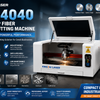
This is exactly the type of problem we had in mind with the XT-4040 Desktop Fiber Laser Cutting Machine.
It is not designed to replace a large industrial cutting system.
And it should not.
If your factory is processing full-size metal sheets all day, a large-format industrial machine is obviously the better choice.
The XT-4040 is aimed at something different:
Small parts, prototypes, customized products, and flexible small-batch production.
Instead of dedicating a large section of the factory to a cutting machine, businesses can bring fiber laser processing into a much smaller working area.
That makes it particularly interesting for smaller companies that previously thought fiber laser cutting equipment was simply too large for their operation.
What Can You Produce With a Small Fiber Laser Cutter?
This is where things become interesting because the applications are much broader than many first-time buyers expect.
Hardware Components
Examples include:
- Metal brackets;
- Mounting plates;
- Small mechanical parts;
- Stainless steel components;
- Customized accessories.
A hardware manufacturer can quickly produce short runs without waiting for an external cutting supplier.
Jewelry Components
For jewelry workshops, compact cutting systems can support:
- Custom designs;
- Prototype development;
- Small metal components;
- Limited production runs.
This is particularly useful when designs change frequently or customers request personalized products.
Advertising and Signage
Advertising companies frequently produce:
- Metal letters;
- Logos;
- Sign plates;
- Decorative elements.
Instead of outsourcing every special shape, some of these jobs can be completed directly in the workshop.
Automotive Customization
Automotive workshops often need parts that are difficult to purchase off the shelf.
For example:
- Custom brackets;
- Mounting plates;
- Modified components;
- Prototype parts.
Being able to produce these parts internally can significantly shorten project lead times.
Education, Research and Product Development
Universities, laboratories, engineering teams, and innovation centers often need one thing above all:
The ability to experiment.
They may only need one part.
Then they change it.
Then they make another.
For this type of work, flexibility is often more important than mass-production speed.
Does In-House Production Automatically Mean Lower Cost?
Not always.
And this is important.
Buying a machine simply because outsourcing feels expensive is not enough.
You still need to consider:
- Machine investment;
- Electricity;
- Assist gas requirements depending on the application;
- Consumables;
- Maintenance;
- Operator time;
- Material cost;
- Production volume.
If you only order a few parts every six months, outsourcing will probably remain cheaper.
But if your company regularly produces customized metal components, prototypes, or small batches, the calculation starts to change.
The correct question is not:
“Is buying a machine cheaper than one outsourced order?”
Of course not.
The better question is:
“What does outsourcing cost our business over the next two or three years?”
That includes money.
But it should also include waiting time, lost flexibility, delayed projects, and missed customer opportunities.
Outsourcing vs In-House Cutting: A Simple Comparison
| Outsourcing | In-House Compact Laser Cutting | |
|---|---|---|
| Initial Investment | Low | Higher |
| Small-Batch Flexibility | Limited | High |
| Prototype Speed | Slower | Fast |
| Design Changes | Requires New Order | Can Be Done Immediately |
| Production Control | Supplier Dependent | Internal Control |
| Minimum Order | Sometimes Required | Produce What You Need |
| Lead Time | Days or Weeks | Potentially Same Day |
| Best For | Occasional Jobs | Frequent Small-Batch Work |
Neither option is automatically better.
It depends on how your business actually operates.
A Simple Example
Imagine a company develops customized metal products.
Every month it outsources:
- 5 prototype jobs;
- 10 small production orders;
- Several design revisions.
The individual cutting cost may not look high.
But every project also requires communication, quotations, waiting, shipping, and inspection.
Now imagine the same company can produce many of those parts internally.
The biggest improvement may not appear on the cutting invoice.
It appears in the workflow.
Before:
Design → Supplier → Wait → Sample → Modify → Supplier Again → Wait
After:
Design → Cut → Test → Modify → Produce
That difference can completely change how quickly a small company responds to customers.
But Don't Buy a Machine Just Because It Is Compact
This is something I think buyers should hear more often.
A small machine is not automatically the right machine.
Before buying any compact fiber laser cutter, you should confirm:
What material will you cut?
Stainless steel, carbon steel, aluminum, brass, copper, and titanium behave differently under laser processing.
What thickness do you actually need?
Do not choose laser power simply because a larger number sounds better.
Choose it according to your real products.
What is your maximum part size?
If most of your components fit comfortably within the machine's working area, a compact system makes sense.
If you regularly process large sheets, it does not.
How many hours per day will the machine run?
Prototype production and continuous industrial production are very different workloads.
What happens after the machine arrives?
Software training, parameter support, spare parts, technical assistance, and troubleshooting matter just as much as the machine itself.
These questions should come before price.
The Real Value Is Not Just Cutting Metal
When people first look at a fiber laser cutter, they naturally focus on:
Power.
Speed.
Thickness.
Accuracy.
Those specifications matter.
But for many small companies, the biggest advantage is actually something else.
Control.
Control over production.
Control over delivery time.
Control over prototypes.
Control over customization.
And control over how quickly you respond when a customer suddenly asks:
“Can you make this?”
Sometimes the ability to answer “Yes, we can make it today” is worth more than saving a few dollars on the cutting cost.
So, Can a Small Fiber Laser Cutter Replace Outsourcing?
For every company?
No.
And it shouldn't.
Outsourcing remains an excellent solution when cutting requirements are occasional, part sizes are large, or production volumes do not justify owning equipment.
But for businesses that regularly need:
- Small metal parts;
- Prototypes;
- Customized components;
- Short production runs;
- Fast design revisions;
a compact fiber laser cutter can move a surprisingly large amount of work back in-house.
The decision should not be based only on machine price.
Look at your entire production process.
How much do you outsource every year?
How long do you wait?
How often do designs change?
How many customer orders could you complete faster if the cutting process were under your own control?
Once you answer those questions, the economics become much clearer.
XT-4040: Designed for Small-Batch and Flexible Metal Production
The XINGTAI LASER XT-4040 Desktop Fiber Laser Cutting Machine was developed for businesses that want professional metal processing capability without moving immediately into a large-format industrial cutting system.
It is particularly suitable for:
- Small workshops;
- Custom manufacturers;
- Jewelry businesses;
- Hardware manufacturers;
- Automotive customization;
- Advertising and signage;
- Product development;
- Education and research.
Rather than thinking of it as a smaller version of a factory laser cutter, it may be more useful to think of it as:
A tool that puts metal cutting capability directly inside your own workshop.
For the right business, that can mean fewer outsourced jobs, faster prototypes, shorter delivery times, and much more production flexibility.
Thinking About Bringing Metal Cutting In-House?
Before choosing a machine, start with your products.
Send us:
- Your material;
- Material thickness;
- Maximum part size;
- Sample drawing or photo;
- Estimated monthly production volume.
We can help evaluate whether a compact fiber laser cutting machine actually makes sense for your application.
Sometimes the answer will be yes.
Sometimes continuing to outsource is the smarter decision.
Either way, understanding the real production requirement should come first.
XINGTAI LASER
WhatsApp: +86 18722099531
Email: rachel@tjxtmachine.com
Website: tjxtmachine.com